Page loading ... Please wait.
 
Baking & Dessert Recipes & Photos
 
Web Joyofbaking.com


About Us

Substitutions

Ingredients

Glossary

Conversions


Home

Recipe Index

New Recipes

Breakfast & Brunch

Bars & Squares

Cakes

Cookies

Comfort Foods

Pies & Tarts

Biscotti

Quick Breads

Muffins

Scones

Shortbreads

English Tea Party

Trifles

Apple Recipes

Lemon Recipes

Strawberry Recipes

Christmas Baking

Christmas Candy

Christmas Cookies

Valentine's Day Desserts

Thanksgiving Baking

Easter Baking

Ice Creams & Ices

Baking History

Bibliography

Blackberry Sorbet Recipe

Printer Friendly Page

Blackberry Sorbet Recipe

Blackberries are big, and black, and shiny, and oh so sweet. The only problem I have with them is that they don't like to be picked. Waverley Root got it right when he said that the English name "brambleberry" is more fitting as "This name highlights the most impressive characteristic of the blackberry, the ferocity with which its fruit is defended by its thorns." 

There are so many ways to use blackberries. Eating them raw with cream is the obvious choice as is pairing them with apples in crisps, pies and tarts. But another, less obvious way, is to use them in a Sorbet. Sorbet (pronounced Sor-BAY) is easier to make then ice cream, as it just involves mixing and freezing pureed fruit, water, sugar, and lemon juice. A Sorbet begins with making a sugar syrup from water and sugar, which is then chilled, and added to the pureed fruit. If you like Sorbets you may want to make a large batch of sugar syrup and keep it on hand in the refrigerator. If you can pick your own blackberries, then by all means use them to make the sorbet. Otherwise I prefer to use frozen unsweetened blackberries, as their flavor is always excellent and they are available year round. 

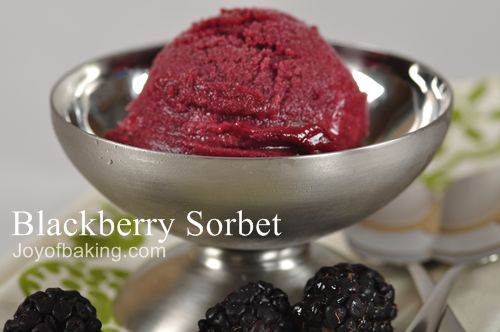
This sorbet is such a beautiful deep burgundy color that is wonderful when served in a pretty glass by itself or in a tall parfait glass, alternating small scoops of vanilla ice cream with the blackberry sorbet. The smoothness of the ice cream is a nice contrast to the grainy texture of the sorbet.

Lastly, a little note on sugar syrups. The density of sugar (simple) syrups can vary from heavy (one part sugar to one part water), medium (one part sugar to two parts water), to light (one part sugar to three parts water) depending on how the sugar syrup is to be used. Sugar syrups have all kinds of uses; soaking cakes and pastries (called a "soaking syrup" and a flavoring can be added such as extracts, juices or liqueurs), diluting fondants, poaching fruit, as a glaze, added to frostings and sorbets, and used in confectionery.


Bring the water to a boil in a small saucepan, remove from heat, and stir in the sugar until it is completely dissolved.  Pour the sugar syrup into a heatproof container, cover and place in the refrigerator until completely chilled (about an hour). 

Meanwhile, thaw the blackberries. When the blackberries are thawed, place in a non-reactive saucepan, along with the cooled sugar syrup, heat to boiling and then simmer for 2-3 minutes. Allow the blackberries and sugar syrup mixture to cool for a few minutes and then transfer to your blender or food processor and process until pureed. Strain the mixture to remove the seeds. Add the lemon juice and liqueur (if using), cover and refrigerate until the mixture is thoroughly chilled. 

Once the mixture is thoroughly chilled place in your ice cream machine and process according to the manufacturer's instructions. Once made, transfer to a chilled container and store in the freezer. When the sorbet becomes solid you will need to place it in the refrigerator for about 20 minutes so it is soft enough to serve.

If you do not have an ice cream machine you can 'still' freeze the sorbet. Pour the mixture into a 8 inch (20 cm) or 9 inch (23 cm) stainless steel pan (sorbets will freeze faster in stainless steel), cover with plastic wrap, and place in the freezer. After about 1 -1 1/2 hours check the sorbet. When the mixture is frozen to the point that a firm ring of ice has formed around the sides of the pan and there is a soft slush of sorbet in the center, remove from the freezer. Transfer the partially thawed sorbet to the food processor and process until the mixture is a uniform slush. This breaks up the large ice crystals that have formed on the sorbet. (This step is what gives the sorbet its wonderful fluffy texture.)  Place the sorbet back into the pan, into the freezer, and repeat the process at least two more times at intervals of 1 - 1 1/2 hours. After the third processing return the sorbet to the freezer for about an hour before serving so the sorbet can be firm enough to serve. 

Makes about 4 cups of sorbet.

Recipe adapted from: Liddell, Caroline and Weir, Robin. Frozen Desserts. New York: St. Martin's Griffin: 1995.


Recipe:

1 cup (240 ml) water

1 1/4 cup (250 grams) granulated white sugar

1 pound (454 grams) frozen unsweetened blackberries

2 tablespoons lemon juice

2 tablespoons fruit liqueur (optional)

Note:  If you taste the sorbet after freezing and find the amount of sugar is not right, adjust the level of sugar by adding a little sugar syrup (too little sugar in sorbet) or water (too much sugar in sorbet) and then refreeze the sorbet.  The sorbet is not affected by thawing and refreezing.

s


Save This Page to del.icio.us


A baking resource on the Internet since 1997

Contact Us   Privacy Policy

All content on this site is either original or has been significantly modified and changed from its credited original source.  Use of materials on Joyofbaking.com is entirely at the risk of the user and Joyofbaking.com or Stephanie Jaworski will not be responsible for any damages directly or indirectly resulting from the use.

This website and the contents thereof are not endorsed or sponsored by the owner of the "Joy of Cooking" series of books or its publisher Simon & Schuster, Inc.

Content in any form may not be copied or used without written permission of Stephanie Jaworski, Joyofbaking.com.  Students and non profit educators may use content without permission with proper credit. 

Copyright  1997 to 2008 Stephanie Jaworski