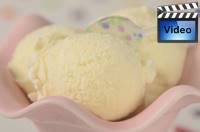
A rich and creamy Philadelphia-style ice cream that's
so easy to make. An eggless mixture of cream, milk, sugar, and vanilla.
more
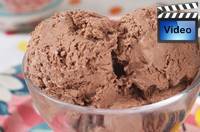
This ice cream tastes like a frozen chocolate mousse. It has a rich
chocolate flavor and creamy smooth texture. Easy to make and you don't need
an ice cream machine.
more
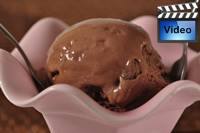
This homemade Chocolate Ice Cream has a wonderfully rich chocolate flavor
and a silky smooth texture. It's like a frozen chocolate mousse. more
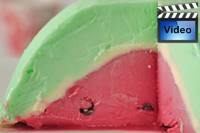
A Watermelon Bombe is a
frozen dessert made by layering lime sherbet, vanilla ice cream and
raspberry sorbet in a mold.
more
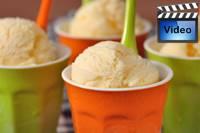
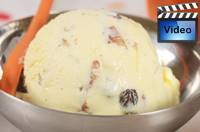
Homemade Vanilla Ice Cream
is made from a custard base which gives it a rich taste and smooth and
creamy texture. more
This vanilla
flavored ice cream is wonderfully rich and creamy smooth. It is made
with just three ingredients, and you don't need an ice cream machine.
more
The
latest Ice Cream Videos
Catch up on all the latest Ice Cream videos
by clicking
A Fruit Smoothie (or Frappe)
is a combination of pureed fruit, yogurt (plain or flavored), juice, and
crushed ice that makes for a delicious drink that is chock full of
nutrients. more
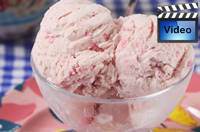
Strawberry Ice Cream is made with strawberry puree which gives it a lovely
strawberry flavor. more
A wonderfully smooth and
creamy ice cream with a deliciously rich strawberry flavor. And you
don't need an ice cream machine as the ingredients are just beaten
together and then frozen.
more
This beautiful caramel colored and flavored
Dulce de Leche Frozen Yogurt is light and sweet, yet refreshingly tangy.
more
Frozen
Chocolate Banana Pops take frozen chunks of banana and dips them in
melted chocolate. They can then be rolled in chopped nuts, toasted
coconut, granola, or candied sprinkles.
more
A deliciously smooth and
creamy vanilla ice cream full of rum soaked dark and golden raisins and
crunchy toasted pecans.
more
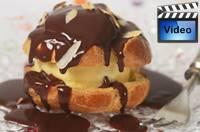
Sweet Profiteroles are
delicious. This dessert takes small, crisp, hollow rounds of choux
pastry and fills them with ice cream and drizzles a warm chocolate sauce
over the top. more
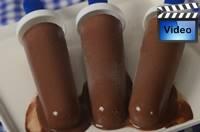
These homemade Frozen
Fudge Pops taste like a frozen chocolate pudding on a stick. Wonderfully
rich and creamy.
more
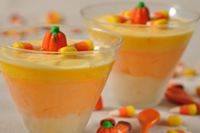
Candy Corn Parfaits
are made by layering vanilla ice
cream, with orange sherbet and lemon sorbet.
more
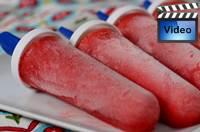
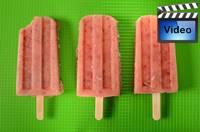
Frozen Fruit Pops are made
from a berry puree, sugar syrup, and fruit juice.
more
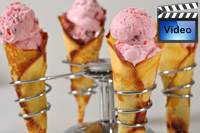
This recipe makes a
crepe-like batter that produces a cone that is a cross between a sugar
cone and a crepe. more
Try
these delicious, icy cold Peach Pops. Full of pureed peaches, mixed with a
sugar syrup and a little Prosecco. So refreshing.
more
Man has always desired a cool drink when
the weather turns hot. Although if we want a drink today all we need to do
is walk to the refrigerator, this was not in case in centuries gone as
refrigerators in every home only happened in the early 20th century and ice
making machines were not invented until the 1850s. It seems amazing now
but for centuries the only way people living in hot climates could cool
their drinks was to have first gathered ice and snow from mountain tops and
frozen rivers and lakes. They would bring back huge blocks of ice and snow
to their village on horseback or by boat and place it in large dug out pits
where the ice would be packed and insulated with grasses, leaves and furs. The pit would then be covered with wooden planks and the ice stored until the
summer months when it was used to cool their drinks. The collecting of snow and
ice in North America became a prosperous business during the winter months. Ice
would be collected from frozen lakes and shipped not only to the warmer southern
states but to many other parts of the world.
The people of the Middle East, with its hot
climate, had to go to great lengths to gather and store the ice and snow. One popular drink, cooled with the ice and snow and sold by street vendors
during the summer months, was the Sherbet. Sherbet was a non alcoholic
sweetened fruit drink known as 'sharab'.
As time went on alcohol was added to this drink so a new name 'sharbat'
was given to the original non alcoholic fruit drink. By the 16th
century ice houses were being built in Europe and the sharbat
also made its way to Europe where it became very popular. In Italy the fruit
drink was called sorbetto (from the verb sorboire meaning 'to sip'), in France
it was called sorbet, in Spain it was called sorbete and the English called it
sherbet. Over time, and with the advent of making artificial ice,
sorbets/sherbets were sometimes frozen and were either served as a drink
or eaten with a spoon.
Marco Polo has often been credited with bringing
ice cream to Europe from China. This story
may or may not be true, but Italy is definitely where ice cream
established its roots. The English quickly adopted ice cream as
they have long enjoyed foods containing milk. Ice cream and ices spread to
America with the first record of it being served was in the 1740s at a
dinner given by the Governor of Maryland. Ice cream quickly spread aided
by the commercial business of ice harvesting in the Northern States. Before long, even in New Orleans (1808) vendors were selling ice cream daily. With our
love of ice cream came many new inventions, the first hand cranked ice
cream freezer (1846), the sundae (1874), the ice cream cone (1904), the
chocolate covered ice cream bar (1919), and the ice cream sandwich,
banana split, ice cream cake, and chocolate covered ice cream bar on a
stick (the Good Humor Ice Cream Sucker) in
the 1920s. So much a symbol of America that in the 1920s when
immigrants arrived at Ellis Island we would serve them ice cream as part
of their first meal in America.
If you have never
made ice cream before then you are in for a treat. The
texture of homemade ice cream is so creamy and smooth and the flavor so
pure, you will not want to ever buy commercial ice creams again.
Sources:
Andrews, Tamra, Nectar and Ambrosia: An Encyclopedia of Food in World
Mythology. Santa Barbara: ABC-CLIO, Inc., 2000.
Ayto, John.
An A-Z of Food & Drink. Oxford: Oxford University Press, 2002.
Davidson, Alan.
The Oxford Companion to Food. Oxford: Oxford University Press,
1999.
Dickson, Paul. The Great American
Ice Cream Book. New York: Galahad Books, 1972.
Friberg, Bo.
The Professional Pastry Chef (Third Edition). New York: Van Nostrand
Reinhold, 1996.
Lawson, Nigella.
Forever Summer. New York: Hyperion, 2003.
Liddell, Caroline and Weir, Robin.
Frozen Desserts. New York: St. Martin's Griffin: 1995.
Marian, John F.
The Dictionary of American Food & Drink, New Haven and New York:
Ticknor & Fields, 1983.
Pence, Caprial
and Carey, Melissa. Caprial's Desserts. Berkeley: Ten Speed
Press, 2001.
Root, Waverley &
de Rochemont, Richard. Eating in America A History. New York:
William Morrow and Company, Inc. 1976.
Root, Waverley, Food. New York: A Fireside
Book, 1980.
Visser,
Margaret. Much Depends on Dinner. New York: Grove Press, 1986.
Use of materials on
all pages on the domains Joyofbaking.com,
the Joyofbaking.com Facebook
Page, the
Joyofbaking1 YouTube
Channel and any emails sent from @joyofbaking.com
are
entirely at the risk of the user and their owner, iFood Media LLC
will not be responsible for any damages directly or indirectly resulting
from the use.
References
cited may include a link to purchase the referenced book or item on Amazon.com.
Joyofbaking.com receives a commission on any purchases resulting from these
links.
This
website and the contents are not endorsed or sponsored by the owner of the
"Joy of Cooking" series of books or its publisher Simon & Schuster, Inc.
and is not related to the "Joy the Baker" books and website.
Video icons by Asher.
Content in any form may
not be copied or used without written permission of Stephanie Jaworski,
Joyofbaking.com. Students and non profit educators may use content without
permission with proper credit.