Page loading ... Please wait.
 
Baking & Dessert Recipes & Photos
 
Web Joyofbaking.com


About Us

Substitutions

Ingredients

Glossary

Conversions


Home

Recipe Index

New Recipes

Breakfast & Brunch

Bars & Squares

Cakes

Cookies

Comfort Foods

Pies & Tarts

Biscotti

Quick Breads

Muffins

Scones

Shortbreads

English Tea Party

Trifles

Apple Recipes

Lemon Recipes

Strawberry Recipes

Christmas Baking

Christmas Candy

Christmas Cookies

Valentine's Day Desserts

Thanksgiving Baking

Easter Baking

Ice Creams & Ices

Baking History

Bibliography

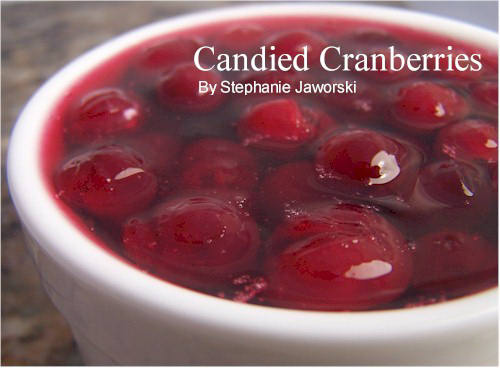
Candied Cranberries Recipe

Printer Friendly Page

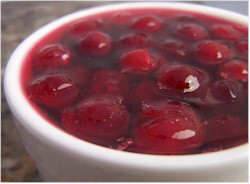
Candied Cranberries Recipe

The cranberry, along with the Concord grape and blueberry, are native to America. This small, hard, smooth-skinned, shiny red, round to oval-shaped wild berry also goes by the names craneberry, bounceberry, bearberry, cowberry, or lingonberry. Cranberries are harvested in the fall from Labor Day (early September) through late October. They can be found in the produce section of grocery stores from October through December. Look for berries that are firm, plump, shiny, and evenly colored (light to dark red). Avoid soft, discolored (white or green ones are under ripe) or shriveled cranberries. Remove stems and wash just before using.

The tartness of the cranberry make it one of the few berries never to be eaten raw. Sugar is needed to temper its tangy flavor. One excellent way to use cranberries is to candy them.  Actually, candying cranberries is very similar to the way you candy the rind of an orange or lemon; where you first simmer the berries in a sugar syrup and then leave them to macerate for a few days. This process of soaking them in a sugar syrup produces a cranberry which is tender and sweet yet, at the same time, retaining that hint of tartness. Now, you can use these candied cranberries, along with their syrup, as a dessert topping over cakes and ice cream or, if the syrup is drained from the berries. You can add them to fillings for cakes or pies. And make sure you do not throw away any leftover syrup from the drained berries, for you can add liqueur to it, and it can be brushed on sponge cakes or added to frostings for both flavor and color.
 

Pick over the cranberries and remove any berries that are soft or rotten and then place 2 cups of cranberries into a 6-8 cup stainless steel (or other heatproof) bowl. The cranberries are going to be 'steamed' so you will need a steamer or pot that is large enough to hold the bowl of cranberries. Fill the large pot or steamer with a few inches (5 cm) of water and bring to a simmer.

Meanwhile, combine the sugar and water in a small saucepan and bring to a boil. Pour the boiling syrup over the cranberries and cover the bowl with a plate. (You need to 'weigh' the bowl down so it will not move around once it is in the pot with the water.)

Set the covered bowl of cranberries into the pot or steamer.  Cover the pot and steam the berries over low to medium heat for about 45 minutes.

Remove from heat and let cool. Cover bowl with plastic wrap and let the berries sit in the syrup for 3 to 4 days at room temperature. The syrup will become a little jellied. If using right away, drain the berries before using, keeping the syrup for some other use. If storing, place the covered berries, still in their syrup, in the refrigerator for up to two weeks.

Makes about 1 1/2 cups of candied cranberries.

Adapted from Cocolat by Alice Medrich

Recipe:

2 cups fresh cranberries, washed

1 1/4 cups (250 grams) granulated white sugar

3/4 cup (180 ml) water


s


Save This Page to del.icio.us


A baking resource on the Internet since 1997

Contact Us   Privacy Policy

All content on this site is either original or has been significantly modified and changed from its credited original source.  Use of materials on Joyofbaking.com is entirely at the risk of the user and Joyofbaking.com or Stephanie Jaworski will not be responsible for any damages directly or indirectly resulting from the use.

This website and the contents thereof are not endorsed or sponsored by the owner of the "Joy of Cooking" series of books or its publisher Simon & Schuster, Inc.

Content in any form may not be copied or used without written permission of Stephanie Jaworski, Joyofbaking.com.  Students and non profit educators may use content without permission with proper credit. 

Copyright  1997 to 2008 Stephanie Jaworski