Page loading ... Please wait.
 
Baking & Dessert Recipes & Photos
 
Web Joyofbaking.com


About Us

Substitutions

Ingredients

Glossary

Conversions


Home

Recipe Index

New Recipes

Breakfast & Brunch

Bars & Squares

Cakes

Cookies

Comfort Foods

Pies & Tarts

Biscotti

Quick Breads

Muffins

Scones

Shortbreads

English Tea Party

Trifles

Apple Recipes

Lemon Recipes

Strawberry Recipes

Christmas Baking

Christmas Candy

Christmas Cookies

Valentine's Day Desserts

Thanksgiving Baking

Easter Baking

Ice Creams & Ices

Baking History

Bibliography

Crème Anglaise (Custard Sauce) Recipe

Printer Friendly Page

Creme Anglaise Recipe

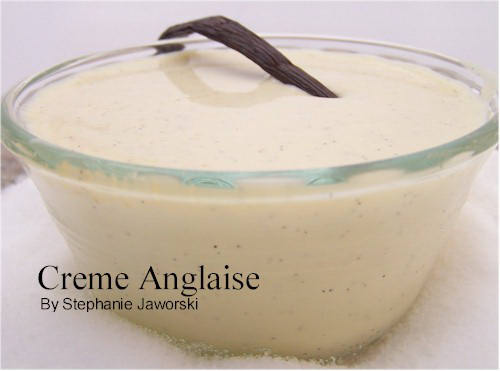
Crème Anglaise (English Cream) is the French translation for custard sauce.  There are two types of custard;  cooked (stirred) and baked.  The difference being that 'baked' custards contain whole eggs and are cooked 'in' a water bath 'in' the oven (think crème brulee).  In contrast, the 'cooked' or 'stirred' custard sauce (presented here) contains only egg yolks and is cooked 'on' the stove, oftentimes 'over' a water bath.  The end result is a nice rich and smooth textured sauce that can be served, warm or cold, with cakes, pies, puddings, or fruit and is ideal for plated desserts.

Cooked custards can vary in richness and consistency, although all are pourable.  The standard proportion for crème anglaise is 5 large egg yolks for every 2 cups of milk.  Extra yolks can be added and light cream (or half and half) can be substituted for the milk to make a richer sauce.  The amount of sugar can vary, depending on sweetness desired, but the standard proportion is 1/4 cup (50 grams) of granulated white sugar.  Traditionally a vanilla bean or pure vanilla extract is added to the sauce although other flavored extracts can be used, as can zests, alcohol, fruit purees, or even melted chocolate. 

Now, cooked custards can also be used as a base for other desserts.  If the custard is thickened with starch (flour/cornstarch) it becomes a pastry cream/crème patisserie and its uses extend to filling tarts, cakes, cream puffs, and éclairs.  Its most famous use is in the English Trifle.  If some of the milk is replaced with heavy cream the custard sauce becomes rich and smooth and is used as a base for ice creams.  Take this custard one step further and add gelatin and whipped cream to it and you now have Bavarian Cream. 

A commercial custard powder is available that consists of cornstarch (cornflour) and artificial flavors (and sometimes sugar).  It was invented by Alfred Bird in Birmingham England in 1837.  Some people prefer this sauce because it is much easier to make and they don't have to be concerned with the eggs curdling. 


Have a fine medium-sized strainer and bowl ready near the stove.

In a stainless steel bowl stir together, using a wooden spoon, the sugar and yolks until well blended. (Do not let this mixture sit too long or a film will develop on the yolks.)

In a small saucepan heat the cream and vanilla bean (if using) just to the boiling point.  Remove from heat and whisk a few tablespoons of the cream into the yolk mixture.  Then, gradually add the remaining cream, whisking constantly.

Pour this mixture into a medium sized saucepan and, over medium heat, gently heat the mixture to just below the boiling point (170 - 175 degrees F) (77 - 80 degrees C).  You will notice that steam will begin to appear and the mixture will be slightly thicker than heavy cream.  Do not boil or the eggs will curdle.  Check to see if it is the right consistency by holding a wooden spoon sideways that is covered with the custard and run your finger along the back of the spoon.  If the streak remains without the cream running down through the streak, it is ready.

Immediately remove from the heat and pour through the strainer, scraping up any thickened cream that settles on the bottom of the pan.  Remove the vanilla bean and scrape the seeds into the sauce.  Stir until seeds separate.  For maximum flavor, return the pod to the sauce until serving time.  (If you are using pure vanilla extract, instead of the vanilla bean, add it to the cream now.)

The crème anglaise can be refrigerated covered with plastic wrap for a couple of days. 

Note:  If sauce was overheated and curdling occurs, pour instantly into a blender and process until smooth before straining.  If necessary, add a little heavy cream to the mixture before blending.

Makes about 2 cups (480 ml).

Crème Anglaise:

2 cups (480 ml) light cream or half and half (12 - 18% butterfat)

1 vanilla bean, split lengthwise (can be found specialty food stores) or 2 teaspoons pure vanilla extract

1/3 cup (66 grams) granulated white sugar

5 large egg yolks


s


Save This Page to del.icio.us


A baking resource on the Internet since 1997

Contact Us   Privacy Policy

All content on this site is either original or has been significantly modified and changed from its credited original source.  Use of materials on Joyofbaking.com is entirely at the risk of the user and Joyofbaking.com or Stephanie Jaworski will not be responsible for any damages directly or indirectly resulting from the use.

This website and the contents thereof are not endorsed or sponsored by the owner of the "Joy of Cooking" series of books or its publisher Simon & Schuster, Inc.

Content in any form may not be copied or used without written permission of Stephanie Jaworski, Joyofbaking.com.  Students and non profit educators may use content without permission with proper credit. 

Copyright  1997 to 2008 Stephanie Jaworski