ot having ever
been to Australia (their home), I only discovered Lamingtons while browsing
through a food magazine. It seems that Lamingtons are one of Australia's
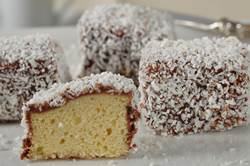
national cakes and consist of a small square of
white cake (sponge, butter, or pound) that is dipped in a sweet chocolate icing
and then rolled in desiccated coconut. I suspect Lord
Lamington (Governor of Queensland from 1896 - 190l), their namesake, might be
surprised at how popular these cakes have become. I am told that
Lamingtons are sold in most Australian bakeries and are very popular at bake
sales. So popular, in fact, that charities have what are called 'Lamington
Drives'
.
To make Lamingtons,
you start with a white cake (home made or store bought) that has been cut into 2 inch (5 cm) squares. The squares of cake are chilled (to make
it easier to frost) and then each square of cake
is covered in a soft chocolate icing. Although
most Lamington recipes advise you to 'dip' each square of cake into the
frosting, I prefer to 'pour', as this prevents crumbs from getting into the icing.
Then roll each square of cake in unsweetened desiccated (dried) coconut. Desiccated coconut
is different than the more common 'sweetened' coconut sold in plastic bags
or cans in grocery stores. It has a sweet coconut flavor and dry (not
sticky) texture. You can find it in health
food store or specialty food store, but if time doesn't permit this extra trip, just use sweetened coconut. These cakes store very well and can be made several
days in advance of serving.
Preheat oven to
350 degrees F (180 degrees C) and place oven rack to middle position. Butter,
or spray with a nonstick cooking spray,
the bottom and sides of an 8 inch (20 cm) square cake pan. Set aside.
In a large bowl
sift or
whisk together the flour, baking powder, and salt. Set aside.
In bowl of electric
mixer, beat the butter until soft. Add the sugar
and beat until light and fluffy (about 2-3 minutes). Add eggs, one at a
time, beating well after each addition. Scrape down the sides of the bowl.
Add the vanilla extract and beat until combined.
With the mixer on low
speed, alternately add the flour mixture and milk, in three additions, beginning
and ending with flour.
Spread the batter into the
prepared pan
and smooth the top with an offset spatula.
Bake in
a preheated oven for approximately 25-30 minutes, or until a
toothpick inserted in the center of the cake comes out clean.
Cool the cake in its
pan on a wire rack for 10 minutes. Place a wire rack on top of the cake pan and
invert, lifting off the pan. Re-invert. Once the cake has completely
cooled cut it into 16 two-inch (5 cm) squares. Wrap the cake in plastic
wrap and refrigerate for several hours or even overnight. The reason for
doing this is that it is much easier (less crumbs) to coat a cold cake with frosting.
Chocolate Frosting: Place
the confectioners' sugar, cocoa powder, butter and milk in a heatproof bowl over
a saucepan of simmering water. Stir the mixture until it becomes smooth
and of pouring consistency.
To assemble Lamingtons:
Make a
production line; put the 16 squares of cakes on a wire rack that is placed over
a
baking sheet (to
catch the drips). Have ready the coconut on a large plate and the
chocolate frosting. Spoon or ladle the chocolate frosting over each square
of cake, making sure you cover all sides. (It is best to do a few squares at a
time.) With a small offset spatula or knife transfer the chocolate covered
cake to the plate of coconut and roll the cake in the coconut, covering all
sides. Gently transfer the lamington to a clean wire rack to set.
Repeat with the rest of the cake squares. Once the Lamingtons have set, store
in an airtight container for several days.
Note: When you ladle the frosting over
the cake, some of the frosting will drip onto the baking pan. Pour this
frosting back in your bowl and reuse (strain if necessary). If the icing becomes too thick to
pour, simply place the frosting back over the saucepan of simmering water and
reheat until it is of pouring consistency. (You may have to do this a few times
as the frosting has a tendency to thicken over time. Add a little more
milk to frosting if necessary to get pouring consistency.)
Makes 16 2-inch (5 cm) squares.
Sources:
Alexander, Stephanie. 'The Cook's Companion'.
Lantern. London: 2004.
'The Australian Women's Weekly', ACP
Publishing Pty Limited. Sydney: 1991.
Hay, Donna. 'Modern Classics Book 2'.
William Morrow. New York: 2003.
All content on this site is
either original or has been significantly modified and changed from its
credited original source. Use of materials on Joyofbaking.com is
entirely at the risk of the user and Joyofbaking.com or Stephanie Jaworski
will not be responsible for any damages directly or indirectly resulting
from the use.
This
website and the contents thereof are not endorsed or sponsored by the owner
of the "Joy of Cooking" series of books or its publisher Simon & Schuster,
Inc.
Content in any form may
not be copied or used without written permission of Stephanie Jaworski,
Joyofbaking.com. Students and non profit educators may use content without
permission with proper credit.