Sometimes we come
upon a new recipe by chance. That is what happened to me with this Lemon Sponge
Pudding recipe. I found this
recipe when I was browsing through my mother's old
cookbooks. There was one cookbook, called "The Family Cook Book" written by the
Culinary Arts Institute in 1943, that encouraged people to cook an entire dinner
menu (appetizer, entree, and dessert) in the oven at the same time. While the
concept of cooking several dishes in the oven at once may seem odd today, if we
look back to 1943, which was a time of food shortages, rationing, and
conservation of fuel, it was a wonderful idea.
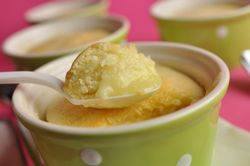
What is so unique about this Lemon Sponge Pudding is what
happens as it bakes - the batter separates into two layers. The top layer
becomes a light and airy sponge cake, yet underneath is a
deliciously tangy lemon sauce. This separation takes place because of the
high proportion of liquid (milk) to the flour and eggs. A Lemon Sponge
Pudding is popular
in many countries, where it can be known as a Lemon Surprise
Pudding, Lemon Pudding Cake, Self-Saucing Lemon Pudding, Lemon Souffle Pudding,
or a Lemon Delicious Pudding.
For this recipe,
we are making individual Lemon Sponge Puddings. You will need six - 1 cup
(240 ml) oven proof baking cups or ramekins. (Ramekins are a lot like a
small souffle dish with their rimmed tops and straight sides that are
smooth on the inside. They can be made of porcelain, earthenware, or
stoneware.) The puddings are baked in a water bath as this provides a
moist and indirect, constant heat so the puddings bake gently and slowly.
This ensures moist and tender puddings, not ones that are tough and
rubbery. To make a water bath, first place the ramekins in a larger baking pan (or any size pan that will fit
the ramekins and leave about 1 inch (2.54 cm) around the edges) and then
carefully pour in enough hot water so that the water comes about halfway
up the sides of the ramekins. Immediately after baking, carefully
remove the ramekins from the water bath to stop further baking.
You can serve this pudding warm from the oven
or at room temperature. I
often dust the tops of the puddings with confectioners (icing or powdered) sugar
and garnish with a dollop of softly whipped cream and fresh fruit. It is always fun to see
your guests' surprise when they dip their spoons into the pudding and find not
only cake on their spoons but also a yummy lemon sauce.
Lemon Sponge
Pudding: Preheat oven to 325 degrees F
(165 degrees C) and place rack in the center of the oven. Butter six - 1
cup (240 ml) ramekins or other heatproof bowls.
Set aside 2 tablespoons (28
grams) of the sugar to use when whipping the egg whites. Then, in the bowl of
your electric mixer, or with a hand mixer, beat the remaining sugar and
butter until light and fluffy. Add the three egg yolks, one at a time, and beat until
incorporated. Beat in the vanilla extract and lemon zest. Add the
flour and salt and beat until combined. With the mixer on low speed,
gradually pour in the lemon juice and milk. Set aside while you beat the
egg whites.
In a clean bowl of your
electric mixer, or with a hand mixer, beat the egg whites until frothy. Add the cream of tartar and continue to beat until soft peaks form. Gradually add the
remaining 2 tablespoons (28 grams) of sugar and beat until stiff peaks form. Gently fold the egg whites into the batter, in three additions, mixing only
until incorporated.
Evenly pour
(or ladle) the batter into the prepared ramekins. (The batter does not rise much
during baking so you can fill the ramekins almost to the rim.) Prepare a
water bath. Place the
ramekins in a larger baking pan (or any size pan that will fit the ramekins and
leave about 1 inch (2.54 cm) around the edges). Carefully pour in enough hot water so that the water is halfway up
the sides of the ramekins.
Bake for about 40 - 45 minutes or until the sponge cakes are golden brown and a
toothpick inserted into the cake portion comes out clean. Be careful
not to insert the toothpick into the lemon sauce at the bottom of the ramekins. Remove the ramekins from the water bath
immediately and cool slightly before serving.
This dessert can
be served warm or at room temperature. Dust the tops of the puddings with
confectioners (powdered or icing) sugar and dress with a dollop of softly whipped cream
and fresh fruit (optional). Leftovers can be covered and stored in the
refrigerator. Excellent cold or you can reheat the puddings in the microwave.
Use of materials on
all pages on the domains Joyofbaking.com,
the Joyofbaking.com Facebook
Page, the
Joyofbaking1 YouTube
Channel and any emails sent from @joyofbaking.com
are
entirely at the risk of the user and their owner, iFood Media LLC
will not be responsible for any damages directly or indirectly resulting
from the use.
References
cited may include a link to purchase the referenced book or item on Amazon.com.
Joyofbaking.com receives a commission on any purchases resulting from these
links.
This
website and the contents are not endorsed or sponsored by the owner of the
"Joy of Cooking" series of books or its publisher Simon & Schuster, Inc.
and is not related to the "Joy the Baker" books and website.
Video icons by Asher.
Content in any form may
not be copied or used without written permission of Stephanie Jaworski,
Joyofbaking.com. Students and non profit educators may use content without
permission with proper credit.