meringue has
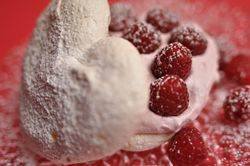
the wonderful ability to satisfy our cravings for something sweet, yet still be light and delicate in texture and flavor. Since meringues pair so well with fruits and creams, for this dessert I have
made individual heart-shaped meringues and topped them with strawberry
cream and fresh strawberries.
Meringues are simply a mixture of stiffly beaten egg whites, cream
of tartar, and sugar. There are two types of meringue; soft
and hard and the difference between the two is the amount of sugar added to
the egg whites. Soft meringues are what we use as a topping for pies (like
Lemon Meringue) and are made with a small amount of sugar. For the
meringues featured in this recipe, however, we need a hard meringue which has a larger
proportion of sugar to egg whites (1/4 cup (50 grams) of sugar for every large
egg white). The wonderful thing about this type of meringue is that it can
be piped into so many different sizes and shapes. he important thing is
to bake them in a slow oven so you end up with a crisp, crumbly, and delicate
meringue. nce baked, hard meringues can be filled with whipped cream,
custards, curds, ice creams, and fresh fruit.
When
making a meringue you want to
ensure that the egg whites reach maximum volume so have your mixing bowl and beaters
clean and free of grease. It is easier to separate your eggs while they
are cold and once separated, cover the egg whites and let them come to room
temperature before using (about 30 minutes). Cover and refrigerate the egg
yolks for another use. Cream of
tartar is a tartaric acid and is a fine white crystalline salt which is a
by-product of the wine-making industry It is used in the whipping of egg
whites to stabilize them and allows them to reach maximum volume. I find
that superfine (caster) sugar always makes the best meringues as it dissolves
easier in the whites and you can make your own by taking 1 cup (200 grams)
granulated white sugar and processing it in your food processor until very fine.
It is important when making meringues to add the
sugar gradually to the egg whites so that the sugar completely dissolves and
does not produce a gritty meringue.
To test to see if the sugar has completely dissolved, rub a little of the
meringue between your thumb and index finger. If it does not feel gritty
it's fine but if it does feels gritty the sugar has not fully dissolved so keep
beating until it feels smooth between your fingers.
Meringues are always baked
in a slow oven to allow the slow evaporation of the moisture out of the
meringues. If the oven temperature is too high, the outside
of the meringue will dry and set too quickly. So instead of a dry,
crisp and crunchy meringue you will end up with
the inside of the meringue being chewy and sticky. Also, try to
make meringues on a dry day because on a rainy or humid day you will probably
need to bake the
meringues longer. Meringues can
be made several days in advance of servings. However, in order to keep the
meringues crisp do not assemble this dessert until shortly before serving.
Preheat
oven to 250 degrees F (130 degrees C) and place racks in upper and lower third
of your oven.
Line two baking sheets with parchment paper. Using a 4 inch (10 cm)
heart-shaped cookie cutter as your guide, draw 6 hearts (12 total) on each piece of parchment
paper. Set aside while you make the meringue.
In the bowl
of your electric mixer, with the whisk attachment, beat the egg whites on
low-medium speed until foamy. Add the cream of tartar and continue to beat
the whites until they hold soft peaks. Add the sugar, a little at a time,
and continue to beat until the meringue holds very stiff peaks. (The
meringue is done when it holds stiff peaks and when you rub a little between
your thumb and index finger it does not feel gritty. If it feels gritty
the sugar has not fully dissolved so keep beating until it feels smooth between
your fingers.) Transfer the meringue to a pastry bag fitted with a 1/2
inch (1.25 cm) plain tip.
Place a
small spot of meringue at each corner of the pan to attach the
parchment paper to the baking sheets. Pipe the
meringue within the perimeters of the 12 heart shapes you have drawn on the
parchment paper. Smooth with an offset spatula.
Bake in
preheated oven for about 60 to 70 minutes, alternating the baking sheets, top to
bottom and front to back, about halfway through baking. (The time does
depend on how humid or dry a day it is.) The meringues are done when they
release easily from the parchment paper. When the meringues are
baked, turn off the oven, open the oven door slightly, and leave the meringues
in the turned off oven for about another half hour.
For the strawberry whipped cream:In a large mixing bowl
combine the whipping cream,
vanilla extract, and sugar. Cover and chill the bowl and beaters in the refrigerator for at
least 30 minutes. When chilled, beat the mixture until soft
peaks form. Then add the sweetened
strawberry puree, a little at a time,
beating just until stiff peaks form when the beater is raised. Taste and
fold in more
sugar or puree, if needed.
To assemble
dessert: With a pastry bag fitted with a star tip, pipe, or else spoon the
whipped cream on top of the meringues and serve with lightly sweetened berries
and extra strawberry puree, if desired.
Note: In the above
picture, I have used two meringues and sandwiched them together with the cream.
Store
leftover meringues in a cool dry airtight container up to one week.
All content on this site is
either original or has been significantly modified and changed from its
credited original source. Use of materials on Joyofbaking.com is
entirely at the risk of the user and Joyofbaking.com or Stephanie Jaworski
will not be responsible for any damages directly or indirectly resulting
from the use.
This
website and the contents thereof are not endorsed or sponsored by the owner
of the "Joy of Cooking" series of books or its publisher Simon & Schuster,
Inc.
Content in any form may
not be copied or used without written permission of Stephanie Jaworski,
Joyofbaking.com. Students and non profit educators may use content without
permission with proper credit.