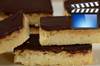
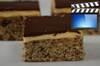
Nanaimo Bars are one of Canada's favorite confections. The beautiful
City of
Nanaimo, British Columbia has claimed them as their own. The story
goes that a Nanaimo housewife entered a recipe for
a chocolate square in a magazine contest. She called her
recipe 'Nanaimo Bars'. She won the contest, and her "Nanaimo Bars"
eventually became popular throughout Canada, as did the town they were named
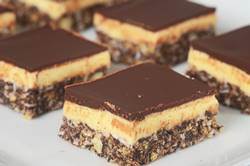
after. These no-bake, three layered bars
are famous for a reason, they are delicious. They start with a Graham
Cracker Crumb base, followed by a
layer of custard buttercream, and the crowning glory is a smooth and
glossy layer of
dark chocolate.
There are many different recipes for
these squares. In fact, when the City of Nanaimo ran a contest back in
1986 to find the 'ultimate' Nanaimo Bar, there were about 100 recipes
submitted. All Nanaimo Bars begin with a base layer, a wonderful
combination of unsweetened cocoa powder (regular or Dutch-processed),
chopped nuts (walnuts or pecans), dried coconut (sweetened or unsweetened)
and graham cracker crumbs (or crushed Digestive Biscuits).
Once this mixture is pressed into a pan and chilled, it is
then covered with a rich layer of buttercream made with butter,
powdered sugar,
custard powder, and a little milk (cream). An important part of this buttercream is the dried custard powder, which was the invention of an
Englishman, named Alfred Bird. He invented this powder because his wife
loved homemade custard but was allergic to eggs. Alan Davidson in his "The
Oxford Companion to Food" tells us that this powder is not, in fact, a
dried form of real custard but is just cornstarch and sugar
that has been colored and flavored. When the dried custard powder is used in this buttercream
it adds a nice flavor and color. Now, if you live in the States, custard powder
can be hard to find. I have found it in some grocery stores, specialty food stores (Bird's
Custard Powder is the most popular brand) or online, but if you are unable
to find it, just
substitute it with an equal amount of instant vanilla pudding, or you can
simply leave it out.
The finishing touch to these squares is a coating of
shiny semisweet or bittersweet chocolate that provides a slight crunch as
you bite into them. For this recipe, because chocolate is one of the more
dominant flavors, make sure to use a good quality chocolate that you enjoy
eating out-of-hand. When choosing a chocolate, always look for one that
has a lovely shiny finish (a sign that the chocolate was cooked at the
right temperature for the right amount of time) and one that has that
wonderful 'snap' when you break it into pieces.
Nanaimo Bars:
Line the bottom and sides of a 9 inch (23 cm) square
pan with foil.
Bottom Layer: In a saucepan over
medium low heat, melt the butter.
Remove from heat and whisk, or stir, in the
sugar and cocoa powder and then gradually whisk in the beaten egg. Return the
saucepan to low heat and cook,
stirring constantly, until the mixture thickens (1 - 2 minutes). Remove
from heat and stir in the vanilla extract, graham cracker crumbs, coconut, and
chopped nuts. Press the mixture evenly onto the bottom of the prepared pan. Cover
with plastic wrap
and refrigerate until firm (about one hour).
Middle Layer:
In your electric stand mixer, fitted with the paddle attachment (or with a hand mixer), beat the butter until smooth and
creamy. Add the
remaining ingredients and beat until the mixture is smooth. If the mixture is too thick to spread, add a little
more milk. Spread the filling evenly over the bottom layer, cover, and
refrigerate until firm (about 30 minutes).
Top Layer: Chop the chocolate into small pieces. Then, in a heatproof
bowl, over a saucepan of simmering water, melt the chocolate and butter. Spread
the melted chocolate evenly over the filling and refrigerate for about 10
minutes or just until the chocolate
has set. Using a sharp knife, cut into squares.
Yield: Makes about 25 squares.
Preparation time 45 minutes.
Use of materials on
all pages on the domains Joyofbaking.com,
the Joyofbaking.com Facebook
Page, the
Joyofbaking1 YouTube
Channel and any emails sent from @joyofbaking.com
are
entirely at the risk of the user and their owner, iFood Media LLC
will not be responsible for any damages directly or indirectly resulting
from the use.
References
cited may include a link to purchase the referenced book or item on Amazon.com.
Joyofbaking.com receives a commission on any purchases resulting from these
links.
This
website and the contents are not endorsed or sponsored by the owner of the
"Joy of Cooking" series of books or its publisher Simon & Schuster, Inc.
and is not related to the "Joy the Baker" books and website.
Video icons by Asher.
Content in any form may
not be copied or used without written permission of Stephanie Jaworski,
Joyofbaking.com. Students and non profit educators may use content without
permission with proper credit.