Page loading ... Please wait.
Tested Baking & Dessert Recipes & Videos

breakfast & brunch bars & squares cupcake recipes shortbread recipes comfort foods recipe box
about us
substitutions
ingredients
glossary
conversions
valentine's baking
chocolate recipes
biscotti recipes
candy recipes
cranberry recipes
healthy baking
pudding recipes
quick breads
english tea party
apple recipes
blueberry recipes
lemon recipes
strawberry recipes
pumpkin recipes
trifle recipes
ice cream recipes
halloween baking
thanksgiving baking
christmas cookies
christmas baking
christmas candy
easter baking
baking history
bibliography

Share

Welsh Cakes Tested Recipe

Printer Friendly Page

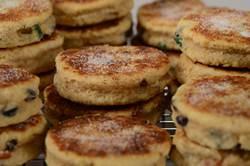
If you are not of Welsh descent you may not be familiar with Welsh Cakes. I think the best way to describe them would be scone-like, albeit in cookie form. The reason I say this is that the two recipes are similar, not only in their ingredients (flour, sugar, baking powder, salt, butter, egg, and milk) but also in technique.

The only real difference is that less milk is used in the Welsh Cake batter because you want a dough that can be rolled and cut into rounds.  Again, as with scones they are often flavored, and while I like to make them as my mother did, with a little ground cinnamon and mace, you could also just add a little mixed spice. Dried fruit is commonly added and here again, I make them as my mother did, with a combination of currants and mixed peel. (Mixed peel or candied citrus peel is preserved fruit that has been dipped several times in a concentrated sugar syrup. It is usually packaged in small plastic tubs.) Now, unlike scones that are baked in a hot oven, Welsh Cakes are cooked on a lightly buttered bake stone, griddle, heavy frying pan, or even an electric frying pan. You can, however, just bake them in a 350 degree F (177 degree C) oven with excellent results, which is what I have been doing lately. Welsh Cakes are fully cooked when they have turned golden brown on both sides, yet the inside of the cakes should still be soft.  A sprinkle of granulated white sugar immediately after cooking adds a nice crunch and whether you eat them plain, buttered, or with jam, they are perfect.


Welsh Cakes: In a large bowl, whisk together the flour, sugar, baking powder, salt, ground cinnamon, and mace. Cut the butter into small pieces and blend into the flour mixture with a pastry blender or two knives. The mixture should look like coarse crumbs. Stir in the currants and mixed peel.  Add the beaten egg and enough milk to form a light dough.

Knead the dough gently on a lightly floured surface and roll to a thickness of 1/4 inch (5 mm). Cut into rounds using a 2 1/2 inch (6 cm) cookie cutter.

Lightly butter a griddle, heavy frying pan, or electric frying pan and heat to medium hot. Cook the welsh cakes for about 5 minutes per side, or until they are golden brown, but still soft in the middle. Immediately after baking, sprinkle with granulated white sugar. Serve warm or at room temperature. 

Welsh cakes can also be eaten buttered or split in half and spread with jam.

Makes about 20 - 2 1/2 inch cakes.

Note:  Welsh Cakes can also be baked in a 350 degree F (177 degree C) oven. Place on a parchment paper lined baking sheet and bake for about 7 - 9 minutes on each side or until set and very lightly browned yet still soft inside (they won't get as brown as when you cook them on a griddle).  They can also be cooked on a baking stone in the oven.  Heat the stone in a 350 degree F (177 degree C) oven and then bake the Welsh Cakes on the stone, turning after about 4 - 5 minutes, or until lightly browned. 

Sources:

Lawrence, Sue. 'Sue Lawrence's Book of Baking'. Headline Book Publishing. London: 2004.

Grigson, Jane. 'Jane Grigson's English Food'. Penguin Books. London: 1974.

Recipe:

2 cups (260 grams) all-purpose flour

1/3 cup (65 grams) granulated white sugar

2 1/4 teaspoons baking powder

1/4 teaspoon salt

1/4 teaspoon ground cinnamon

1/4 teaspoon ground mace

1/2 cup (113 grams) cold unsalted butter

1/3 cup (50 grams) currants or raisins

1/4 cup (40 grams) chopped Mixed Peel (candied citrus peel)

1 large egg, lightly beaten

2 - 4 tablespoons milk

Note: Mixed peel or candied citrus peel is preserved fruit that has been dipped several times in a concentrated sugar syrup. It is usually packaged in small plastic tubs.


Share


Join Our New  Recipes & Videos Email List

New Videos


Top 40 Recipes of 2011

1. Red Velvet Cake

2. Vanilla Cupcakes

3. Chocolate Chip Cookies

4. Royal Icing

5. New York Cheesecake

6. Peanut Butter Balls

7. Chocolate Cupcakes

8. Carrot Cake

9. Sugar Cookies

10. Shortbread Cookies

11. Whipped Cream Frosting

12. Red Velvet Cupcakes

13. Ganache 14. Oatmeal Cookies 15. Pound Cake
16. Coconut Macaroons 17. Chocolate Truffles 18. Fruit Tart 19. Pavlova 20. Gingerbread Men
21. Banana Bread 22. Snickerdoodles 23. Apple Pie 24. Meringue Cookies 25. Yellow Butter Cake
26. Apple Crisp 27. Lemon Curd 28. Nanaimo Bars 29. Molten Chocolate Cakes 30. Cream Scones
31. Brownies 32. Rum Balls 33. Biscuits 34. Pumpkin Pie 35. Lemon Bars
36. Mexican Wedding Cakes 37. Melting Moments 38. Boston Cream Pie 39. Chocolate Crinkles 40. Butter Tarts


Contact Us   Privacy Policy Follow Joyofbaking On Twitter Stephanie Jaworski+

Use of materials on all pages on the domains Joyofbaking.com, joyofbaking.mobi, the Joyofbaking.com Facebook Page, @joyofbaking on Twitter, the Joyofbaking.com RSS Feed, the Joyofbaking.com email list the Joyofbaking1 YouTube Channel and any emails sent from @joyofbaking.com are entirely at the risk of the user and their owner, iFood Media LLC will not be responsible for any damages directly or indirectly resulting from the use.

This website and the contents are not endorsed or sponsored by the owner of the "Joy of Cooking" series of books or its publisher Simon & Schuster, Inc. Video icons by Asher.

Content in any form may not be copied or used without written permission of Stephanie Jaworski, Joyofbaking.com.  Students and non profit educators may use content without permission with proper credit. 

A baking resource on the Internet since 1997

Copyright  1997 to 2012 iFood Media LLC