Page loading ... Please wait.
 
Baking & Dessert Recipes & Pictures

 
breakfast & brunch bars & squares biscotti recipes shortbread recipes comfort foods quick breads
about us
substitutions
ingredients
glossary
conversions
english tea party
pumpkin recipes
apple recipes
cranberry recipes
blueberry recipes
lemon recipes
strawberry recipes
trifle recipes
ice cream recipes
pudding recipes
christmas baking
christmas cookies
christmas candy
thanksgiving baking
easter baking
valentine's baking
baking history
bibliography


Bookmark and Share

Yellow Butter Cake with Chocolate Frosting Recipe

Printer Friendly Page

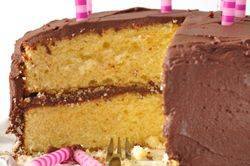
This is your classic layer cake that we enjoy at special occasions like birthdays and anniversaries.  It consists of two layers of a moist yellow butter cake that are filled and frosted with a smooth and creamy chocolate frosting that contains both semi sweet (or bittersweet) chocolate and cocoa powder. 

Before we begin I should first explain the difference between a yellow and a white butter cake.  If we put the mixing methods aside, we find that while the two batters both contain butter, sugar, eggs, flour and milk, the difference is that a yellow cake contains just the egg yolks, whereas a white cake contains whole eggs. Now, this cake recipe comes from Rose Levy Beranbaum's Cake Bible and it uses a slightly different method to mix the batter.  Instead of the more common 'creaming' method where the butter and sugar are creamed together first and then the eggs, followed by the flour and milk are added, this recipe uses the 'one bowl' or 'quick method'.   This is where all the dry ingredients are first put into a mixing bowl and then room temperature butter, along with a little milk, are added.  These ingredients are beaten together and then the eggs, vanilla extract, and remaining milk are added.  The reason for adding the liquid 'after' the butter and flour have been combined, (instead of 'with' the flour) is to reduce the gluten formation in the flour.  This can only happen if the butter has first had the chance to coat all of the flour before the milk is added which has a toughening affect.  The thing about this method is that it makes a cake that literally seems to melt-in-your-mouth and it has a very moist, dense, and velvety texture.  The only downside to this method is that you will notice that the cake layers do not have quite the volume of cakes that are made with the creaming method.  I do think, however, that it is well worth sacrificing a little volume to get such outstanding taste and texture.   The most important thing to remember when making this type of cake is to have all the ingredients at room temperature and to make sure you follow the instructions on mixing.


Preheat oven to 350 degrees F (177 degrees C).  Spray two 9-inch x 1 1/2 inch (23 x 3.75 cm) cake pans with Bakers Joy, line bottoms with parchment paper, then spray again with Bakers Joy.  Set aside.

In a medium bowl lightly combine the egg yolks, 1/4 cup (60 ml) milk, and vanilla extract.

In the bowl of your electric mixer combine the dry ingredients (flour, sugar, baking powder and salt) and mix on low speed for about 30 seconds or until blended.  Add the butter and remaining 3/4 cup (180 ml) milk.  Mix on low speed until the dry ingredients are moistened.  Increase the mixer speed to medium and beat for about 2 minutes to aerate and develop the cake's structure.  Scrape down the sides of the bowl.  Gradually add the egg mixture, in 3 additions, beating about 30 seconds after each addition to incorporate the egg.  

Divide the batter and pour into the prepared pans, smoothing the surface with an offset spatula.  (Pans will be about half full.)  Bake 25 to 35 minutes or until a toothpick inserted into the center of the cake comes out clean and the cake springs back when pressed lightly in center.  

Place the cakes on a wire rack to cool, in their pans, for about 10 minutes.  Then invert the cakes onto a greased rack.  To prevent splitting, reinvert cakes so that tops are right side up.  Cool completely before frosting.

Frosting:  In a stainless steel bowl over a saucepan of simmering water, place the chopped chocolate, cocoa powder, milk, and butter.  Stir until the chocolate has melted and the mixture is smooth.  Remove from heat and beat in, with a hand mixer or wire whisk, the confectioners sugar and vanilla extract.  If the frosting is lumpy, strain through a strainer to remove any lumps.  Cover and place the frosting in the refrigerator until it is firm (this may take a few hours).  Once the frosting is firm remove from refrigerator and place in your mixing bowl.  Beat the frosting for a minute or two or until it is nice and smooth and of spreading consistency.

Assemble:  Place one cake layer on your serving plate and spread with about 3/4 cup of frosting.  Place the other cake layer on top of the frosting and cover the entire cake with the remaining frosting.  Cover and refrigerate the cake until serving time.

Makes one - 9 inch (23 cm) layer cake.

Adapted from 'Cake Bible' by Rose Levy Beranbaum and 'Desserts' by Bonnie Stern.

Recipe:

6 large egg yolks

1 cup (240 ml) milk

2 teaspoons (8 grams) pure vanilla extract

3 cups (300 grams) sifted cake flour

1 1/2 cups (300 grams) granulated white sugar

1 tablespoon + 1 teaspoon (20 grams) baking powder

3/4 teaspoon (5 grams) salt

12 tablespoons (170 grams) unsalted butter, room temperature and cut into pieces

Frosting:

8 ounces (225 grams) bittersweet or semisweet chocolate, chopped

1/4 cup (25 grams) cocoa powder (can use Dutch-processed or regular unsweetened cocoa powder)

3/4 cup (180 ml) milk

1/2 cup (113 grams) unsalted butter, cut into pieces

3 cups (345 grams) confectioners (powdered or icing) sugar, sifted to remove lumps

1 1/2 teaspoon pure vanilla extract


Join Our New & Featured Recipes Email List


Top 40 Recipes of the Last Year*

*Top 40 Recipes based on actual site traffic from June 1, 2008  to May 31, 2009.

Contact Us   Privacy Policy

Arabic Chinese Dutch French German Hindu Indonesian Italian Japanese Korean Norwegian Portuguese Russian Spanish Greek Swedish Finnish

Use of materials on Joyofbaking.com is entirely at the risk of the user and Joyofbaking.com, Stephanie Jaworski or Rick Jaworski will not be responsible for any damages directly or indirectly resulting from the use.

This website and the contents are not endorsed or sponsored by the owner of the "Joy of Cooking" series of books or its publisher Simon & Schuster, Inc.

Content in any form may not be copied or used without written permission of Stephanie Jaworski, Joyofbaking.com.  Students and non profit educators may use content without permission with proper credit. 

A baking resource on the Internet since 1997

Copyright  1997 to 2009 Stephanie & Rick Jaworski