Cherry
Clafoutis
or Clafouti (pronounced kla-foo-TEE) is a rustic looking French country dessert from
the Limousin region that has become very popular in North America. Traditionally
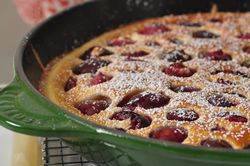
it was made with the first sweet cherries of
the season, and the cherries were left unpitted so their kernels could release
their delicate almond flavor as they baked. It is a pudding
(custard) of sorts, very similar to the Apple
Popover (pancake) recipe on the site. A Cherry Clafoutis is made by
covering sweet cherries with a pancake-like batter and
then baking it
in a hot oven until the batter has set with nicely browned, and slightly puffed edges. The clafoutis should be served immediately,
while it is still warm, with a
dusting of confectioner's (powdered or icing) sugar.
Today, a lot of people prefer
this dish with pitted cherries, which makes the clafoutis much easier to eat. Although clafoutis
is considered a dessert, I usually serve it as a Breakfast or Brunch dish.
The batter is easily made in your food processor or blender, although it
can also be made by hand. Just mix the dry ingredients together in one
bowl, whisk the wet ingredients together in another bowl, and then combine
the two. If you are planning to serve the clafoutis as a dessert, you may
want to use a mixture of cream and milk (instead of just milk) to make the
clafoutis slightly richer in texture and taste. As I said above, the clafoutis
is best served warm with a
dusting of confectioner's (powdered or icing) sugar and maybe a small dollop
of yogurt, creme fraiche, vanilla ice cream, or even softly whipped cream. Although fresh
cherries have a short season, we can enjoy this dish
during the rest of the year. Instead of fresh cherries we can use bottled or
canned cherries that are packed in a syrup. Just be sure to drain the
cherries before using. If you want to make a clafoutis with other fruits,
may I suggest using blackberries, blueberries, raspberries, apples, plums, peaches, pears,
cranberries, or nectarines. The only thing to keep in mind is that
you may have to adjust the sugar depending on the sweetness of the fruit.
As always, it is important to choose our fruit carefully. Buy Bing cherries that
have their stems still attached, are bright and shiny red, almost black in
color. They should be plump, firm to the touch, with no browning around the stems. Do not buy cherries that are soft or
have brown spots, cuts, are wet or sticky, or have shriveled stems.
Pitting the cherries is always a tedious job and the task is made easier if you
have a cherry pitter. However, if you do not own such a tool, than you
need to do it by hand. The easiest way I have found to do this, is to make
a small slit in the cherry, with a small sharp knife, at the stem end of the
cherry. Then, using the tip of the knife or your thumbnail, remove the
pit. This process is best done over a bowl so any dripping juice will fall
into the bowl and not stain your countertop. Because the cut cherries
immediately start to release their juices, it is important to use them right
away.
Cherry Clafoutis: Preheat the oven to 425 degrees F (220 degrees
C) and place the rack in the center of the oven. Wash the cherries, remove
the stems and pits.
In your food processor
or blender (or you can do it by hand with a wire whisk) place the flour, salt, eggs,
sugar, milk,
butter, and vanilla extract. Process for about 60 seconds, scraping down the
sides of the bowl as needed. Once the batter is completely smooth, let it rest
while you prepare the fruit.
In a 9- inch (23 cm) heavy ovenproof skillet
(preferably non stick), melt the butter over medium heat making
sure the melted butter coats the bottom and sides of the pan. When the
butter is bubbling, add the pitted cherries, and cook until the cherries have
softened a bit and are coated with butter (about 2 minutes). Then sprinkle
the cherries with the sugar and cook until the sugar has dissolved and turns
into a syrup (1 - 2 minutes). Pour the batter over the cherries and bake
for about 18-20 minutes or until the clafoutis is puffed, set, and golden brown
around the edges. Do not open the oven door until the end of the
baking time or it may collapse. Serve immediately with a dusting of
confectioners sugar and yogurt, creme fraiche or softly whipped cream.
Use of materials on
all pages on the domains Joyofbaking.com,
the Joyofbaking.com Facebook
Page, the
Joyofbaking1 YouTube
Channel and any emails sent from @joyofbaking.com
are
entirely at the risk of the user and their owner, iFood Media LLC
will not be responsible for any damages directly or indirectly resulting
from the use.
References
cited may include a link to purchase the referenced book or item on Amazon.com.
Joyofbaking.com receives a commission on any purchases resulting from these
links.
This
website and the contents are not endorsed or sponsored by the owner of the
"Joy of Cooking" series of books or its publisher Simon & Schuster, Inc.
and is not related to the "Joy the Baker" books and website.
Video icons by Asher.
Content in any form may
not be copied or used without written permission of Stephanie Jaworski,
Joyofbaking.com. Students and non profit educators may use content without
permission with proper credit.