Page loading ... Please wait.
 
Baking & Dessert Recipes & Photos
 
Web Joyofbaking.com


About Us

Substitutions

Ingredients

Glossary

Conversions


Home

Recipe Index

New Recipes

Breakfast & Brunch

Bars & Squares

Cakes

Cookies

Comfort Foods

Pies & Tarts

Biscotti

Quick Breads

Muffins

Scones

Shortbreads

English Tea Party

Trifles

Apple Recipes

Lemon Recipes

Strawberry Recipes

Christmas Baking

Christmas Candy

Christmas Cookies

Valentine's Day Desserts

Thanksgiving Baking

Easter Baking

Ice Creams & Ices

Baking History

Bibliography

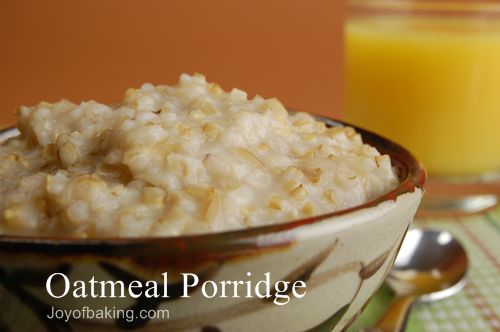
Oatmeal Porridge Recipe

Printer Friendly Page

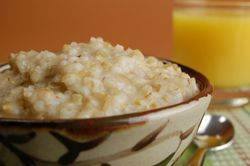
As a child, many cold winter mornings would begin with the wonderful smell of oats cooking on the stove. Once that steaming bowl of hot porridge was placed before me I would dress it with a spoonful of soft brown sugar and, if we were lucky, rich cream that had been skimmed from the milk. The porridge of my youth, made with rolled oats, is not what I enjoy today. Then, my mother used 'rolled' oats which are oats that have been cleaned, toasted, hulled, steamed and then flattened into flakes and, depending on the thickness of the flakes, are labeled either 'old-fashioned' or 'quick-cooking' (old-fashioned being thicker than quick cooking). Today I make my porridge with 'steel-cut' Irish Oatmeal which has a hearty oat flavor and chewy, not mushy, texture. 

Steel-cut oatmeal and rolled oats look very different from each other, for steel-cut means the oats are 'cut' not 'rolled', so instead of flakes of oats you have tiny hard bits of golden oatmeal (think of mini rice particles). Of course, it is always nice to consult an expert when making a new dish, so for advise on making a good bowl of porridge I turned to Marian McNeill and her cookbook 'Recipes from Scotland'. Her advise is sound; start with a good quality oatmeal, fresh spring water (or at least filtered), and a thick bottomed pot. Boil the water and then add the oatmeal by "letting it fall in a steady rain from the left hand whilst you stir it with the right". Add a little salt and then cook the oatmeal until it is of good taste and quality, usually between 20 - 30 minutes. Do not overcook or you will end up with a "gluey, flavourless mess". The interesting part of her instructions is how you should eat your porridge. She tells us to have two bowls; one bowl for the porridge and another bowl for cold milk or cream. You are to first dip your spoon in the porridge and then take the spoonful of porridge and dip it into the cold milk. This gives you the delicious contrast of hot oatmeal and shocking cold milk. It is little wonder that she refers to porridge as "food for the gods". 

If you are not familiar with 'steel-cut' Irish Oatmeal the most readily available brand in North America is 'John McCann's Irish Oatmeal'. It is sold in 28 ounce (783 gram) metal canisters. You can find this brand at some grocery stores, most specialty food stores or on-line (Google 'John McCann's Irish Oatmeal'). 

In a medium sized saucepan bring the 4 cups of water to boil.  Sprinkle the oatmeal over the boiling water, stirring constantly to prevent any lumps from forming.  Add the salt and reduce the heat to low and allow the porridge to simmer for 30 minutes, stirring occasionally.

Serve with brown or white sugar and rich milk or cream.

Leftovers can be covered and refrigerated for another morning.  To reheat, simply add a little hot water or milk to thin out the porridge and then place in the microwave or in a heatproof bowl over a saucepan of simmering water until warm.

Makes 4 servings.

Oatmeal Porridge Recipe:

4 cups (1 liter) water

1 cup (180 grams) steel-cut Irish Oatmeal

1/4 teaspoon salt

For Garnish:

Brown or White Sugar and Rich Milk or Cream

Sources:

Cunningham, Marion. 'The Breakfast Book'. New York: Wings Books, 1987.

Davidson, Alan. The Oxford Companion to Food. Oxford: Oxford University Press, 1999.

Mariani, John F. The Dictionary of American Food & Drink, New Haven and New York: Ticknor & Fields, 1983.

McNeill, F. Marian. 'Recipes from Scotland'. The Albyn Press. Edinburgh: 1946.

Norwak, Mary. 'The English Farmhouse Kitchen'. Follett Publishing Company. Chicago: 1975.

Thorne, John. 'Simple Cooking'. North Point Press. New York: 1980.

s


Save This Page to del.icio.us


A baking resource on the Internet since 1997

Contact Us   Privacy Policy

All content on this site is either original or has been significantly modified and changed from its credited original source.  Use of materials on Joyofbaking.com is entirely at the risk of the user and Joyofbaking.com or Stephanie Jaworski will not be responsible for any damages directly or indirectly resulting from the use.

This website and the contents thereof are not endorsed or sponsored by the owner of the "Joy of Cooking" series of books or its publisher Simon & Schuster, Inc.

Content in any form may not be copied or used without written permission of Stephanie Jaworski, Joyofbaking.com.  Students and non profit educators may use content without permission with proper credit. 

Copyright  1997 to 2008 Stephanie Jaworski