eanut
Butter Balls are a perfect example of how something that tastes great can
also be easy to make. The best way to describe their flavor is to
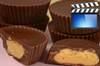
say they are like a Reese's Peanut Butter Cup. It has
that same
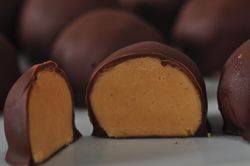
lovely coating of chocolate with a smooth and creamy filling that is almost
fudge-like in texture made of peanut butter, confectioners (powdered or
icing) sugar, butter, and vanilla extract.
The State of Ohio has their own special name for this confection;
"Buckeyes". Buckeyes look slightly different than Peanut Butter Balls in
that the top of each bonbon is bare of chocolate. This is done to
make it look like the nut of the Buckeye tree, which just happens to be
the State Tree of Ohio. So
popular are "Buckeyes" in Ohio that I recently read in the the Cleveland
Dealer that a Ohio State versus Michigan game wouldn't be complete without
these little gems. A bit of trivia; the name "buckeye" comes from Native American folklore
and is said to come from the fact that the Buckeye nut resembles the eye
of a buck deer.
Making Peanut Butter Balls couldn't be simpler. The filling ingredients
are just mixed together, rolled into small balls, chilled, and then dipped
in melted chocolate. A few notes on making this confection. I have found
the best way to make the filling is to first soften the butter and peanut
butter in the microwave as this step makes it so much easier to beat in
the sugar. Also, since the Peanut Butter Balls need to be stored in the
refrigerator, adding a little shortening to the melted chocolate keeps the
chocolate nice and shiny. I know that some recipes call for the addition
of paraffin wax, instead of shortening to keep the chocolate shiny, but
since paraffin wax is
indigestible to humans and simply passes through the body, I prefer
shortening.
Did you know that peanut butter is an American invention and was first touted as a
"health" food? Dr. Kellogg came up with its invention in the 1890s when,
as a vegetarian, he wanted a substitute for what he called "cow's butter".
His answer was "nut butters" and since peanuts (really a legume, not a
nut) were the cheapest nut, that is the "nut butter" he focused on. Peanut
Butter was an instant success and recipes for making and using
peanut butter were in many vegetarian cookbooks by the early 1900s. Not surprisingly,
even in the early 1900s, one of the most popular ways to use peanut butter
was in the peanut butter sandwich.
Peanut
Butter Balls: Line a baking sheet with parchment paper.
Place the peanut
butter, unsalted butter, and salt in a microwaveable bowl, and heat in the microwave for
about one minute or until just soft (check and stir the ingredients every 20
seconds). Stir in the vanilla extract and confectioners sugar and mix until it
has the consistency of a dough (add more sugar if necessary).
Roll the dough
into 1 inch (2.5 cm) round balls. Place on the cookie sheet and refrigerate for
about one hour, or until firm.
Melt the chocolate
and shortening in a heatproof bowl over a saucepan of simmering water. Dip the
balls, one at a time, in the melted chocolate, making sure the entire ball is
coated with chocolate. Then, with two spoons or a dipping fork, remove the
peanut butter ball from the melted chocolate, allowing any excess chocolate to
drip back into the bowl. Place the chocolate covered balls back on the baking sheet. When all the balls have
been dipped in the chocolate, place in the refrigerator until the chocolate has
set. Store in an airtight container for up to two weeks. To serve: place in small
fluted candy cups.
Note: If you want
to make Buckeyes: place a toothpick into each peanut butter ball and dip, one
ball at a time, into the melted chocolate, leaving the top quarter of each ball undipped.
Makes about 40
pieces, depending on size.
Sources:
Jones, David.
Candy Making for Dummies. Wiley Publishing, Inc. New Jersey: 2005.
Peery, Susan
Mahnke. The Wellesley Cookie Exchange Cookbook. A Fireside Book. New
York: 1986.
Smith, Andrew F.
The Oxford Companion to American Food and Drink. Oxford University Press.
New York: 2007.
Peanut Butter Balls
2 cups
(500 grams) creamy peanut butter
1/4 cup
(57 grams) unsalted butter, room temperature
All content on this site is
either original or has been significantly modified and changed from its
credited original source. Use of materials on Joyofbaking.com is
entirely at the risk of the user and Joyofbaking.com or Stephanie Jaworski
will not be responsible for any damages directly or indirectly resulting
from the use.
This
website and the contents thereof are not endorsed or sponsored by the owner
of the "Joy of Cooking" series of books or its publisher Simon & Schuster,
Inc.
Content in any form may
not be copied or used without written permission of Stephanie Jaworski,
Joyofbaking.com. Students and non profit educators may use content without
permission with proper credit.