Page loading ... Please wait.
 
Baking & Dessert Recipes & Photos
 
Web Joyofbaking.com


About Us

Substitutions

Ingredients

Glossary

Conversions


Home

Recipe Index

New Recipes

Breakfast & Brunch

Bars & Squares

Cakes

Cookies

Comfort Foods

Pies & Tarts

Biscotti

Quick Breads

Muffins

Scones

Shortbreads

English Tea Party

Trifles

Apple Recipes

Lemon Recipes

Strawberry Recipes

Christmas Baking

Christmas Candy

Christmas Cookies

Valentine's Day Desserts

Thanksgiving Baking

Easter Baking

Ice Creams & Ices

Baking History

Bibliography

Boston Cream Pie Recipe

Printer Friendly Page

Boston Cream Pie Recipe

here are two questions that immediately come to mind when you hear Boston Cream Pie.  One is "Why is it called a pie?", and the other is "Why the name 'Boston'?". To answer the first question of why "pie" instead of "cake", it is probably because colonists baked their cakes in pie tins as they did not own cake pans. As far as calling it Boston Cream Pie, the story began when a New York newspaper in 1855 published a recipe for a 'Pudding Pie Cake'. This recipe was similar to the Boston Cream Pie recipe of today except that it had a powdered sugar topping. From there we go to Boston where a man named Harvey D. Parker opened a restaurant called the Parker House Restaurant. On the menu was a 'Parker House Chocolate Pie', the recipe to which was similar to the New York newspaper recipe except a chocolate glaze had replaced the powdered sugar topping. We are not sure how it was renamed to 'Boston Cream Pie', but Bo Friberg in his book 'The Professional Pastry Chef' thinks "the name stems from the original title (in the New York paper) combined with the reference to Boston."

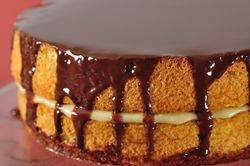
For those unfamiliar with this dessert, it consists of two layers of white sponge or butter cake that are sandwiched together with pastry cream. A chocolate glaze is then poured over the top of the cake and allowed to drip down the sides. For this recipe I have used a sponge cake but you could use your favorite butter cake recipe if you like. The filling, a classic pastry cream (crème patisserie), is a rich, thick, vanilla flavored custard made from a mixture of milk, eggs, sugar, flour and cornstarch (a thickener) cooked on the stove. Its mild taste and creamy texture goes so well with the flavors and textures of both the sponge cake and chocolate glaze. Although there are different types of chocolate glaze that can be used on a Boston Cream Pie, this recipe combines semi-sweet chocolate with cream (really a ganache) and has a mild chocolate flavor. Once the cake is assembled it is best served within a few hours. Leftovers can be covered and stored in the refrigerator. 


Pastry Cream: In a medium-sized stainless steel bowl, mix the sugar and egg yolks. (Do not let this mixture sit too long or you will get pieces of egg forming.) Sift the flour and cornstarch together and then add to the egg mixture, mixing until you get a smooth paste. Set aside.

Meanwhile in a small saucepan, bring the milk just to a boil over medium heat. (Watch carefully and remove from heat just as the milk starts to foam up.) Pour the milk slowly into the egg mixture, whisking constantly to prevent curdling. (If you get a few pieces of egg (curdling) in the mixture, pour through a strainer.) 

Place the egg mixture into a medium saucepan and cook over medium heat until boiling, whisking constantly. When it boils, continue to whisk constantly for another 30 - 60 seconds until it becomes thick.

Remove from heat and whisk in the vanilla extract. Pour into a clean bowl and immediately cover the surface with plastic wrap to prevent a crust from forming. Let the cream cool in the refrigerator for a few hours.

Sponge Cake: Preheat oven to 350 degrees F (177 degrees C) and place rack in center of oven. Butter and line the bottoms of two - 8 inch (23 cm) round cake pans with parchment paper. 

While the eggs are still cold separate three of the eggs, placing the yolks in one large mixing bowl and the whites in another bowl. To the yolks, add the two remaining eggs. Cover the two bowls with plastic wrap and allow the eggs to come to room temperature before using (about 30 minutes).

Meanwhile, in a small bowl whisk together the flours, baking powder, and salt. Set aside.

Place the milk and butter in a small saucepan, over low heat, and warm until the butter melts. Remove from heat, cover, and keep warm.

In your electric mixer, fitted with the paddle attachment, (or with a hand mixer) beat the whole eggs and yolks and 6 tablespoons (75 grams) of the sugar on high speed for about five minutes, or until they are thick, fluffy and light colored (when you slowly raise the beaters the batter will fall back into the bowl in a slow ribbon). Beat in the vanilla extract. 

In another clean mixing bowl, with the whisk attachment, (or with a hand mixer) beat the egg whites and cream of tartar, at low speed, until foamy. Increase the speed to medium-high and gradually add the remaining sugar, beating until soft, moist peaks form. Gently fold a little of the whites into the batter to lighten it, and then add the rest of the whites folding just until incorporated. Sift half of the flour mixture over the top of the batter and gently fold through with a rubber spatula or whisk. Sift the remaining flour over the batter and fold in. Do not over mix.

Make a well on one side of the batter and pour the melted butter/milk mixture into the bowl. Gently but thoroughly fold the butter mixture into the batter. Do not over mix.

Divide the batter between the two prepared pans, smoothing the tops, and bake for about 18-20 minutes or until light brown and springy to the touch. (A toothpick inserted in the middle will come out clean.) Remove from oven and place on a wire rack to cool. Immediately run a spatula or sharp knife around the inside of the pans and then invert the cakes onto a wire rack. Remove parchment paper and re-invert. Cool completely.

When the cakes have cooled and you are ready to assemble the Boston Cream Pie, make the Chocolate Glaze: Place the chopped chocolate in a small heatproof bowl. Bring the cream and butter just to a boil in a saucepan over medium heat. Immediately pour the boiling cream over the chocolate and allow to stand for a 3-5 minutes. Gently stir until smooth. Set aside for a few minutes until it has thickened to pouring consistency.

To Assemble: Place one cake layer on your serving plate, bottom side facing up. Spoon the pastry cream onto the cake, spreading to make an even layer. Place the second cake layer (bottom side up) onto the filling. Pour the glaze onto the center of the cake and carefully spread the glaze, with an offset spatula, to the edges of the cake, allowing the glaze to drip down the sides. Let the cake sit until the glaze sets, about one hour. Serve. This cake is best eaten the same day it is made. Cover and refrigerate any leftovers.

Serves 8-10

Sources:

Editors of Cook's Illustrated. Baking Illustrated. America's Test Kitchen. Brookline, 2004.

Friberg, Bo. The Professional Pastry Chef (Second Edition). New York: Van Nostrand Reinhold, 1990

Hay, Donna. Modern Classics Book 2. New York: HarperCollins Publishers Inc., 2003.

Mariani, John F. The Dictionary of American Food & Drink, New Haven and New York: Ticknor & Fields, 1983.

Pastry Cream:

1/4 cup (50 grams) granulated white sugar

3 large egg yolks

1/8 cup (20 grams) all-purpose flour

Scant 3 tablespoons (20 grams) cornstarch

 1 1/4 cups (300 ml) milk

1 teaspoon vanilla extract

Sponge Cake:

5 large eggs

3/4 cup (150 grams) granulated white sugar, divided

1/2 teaspoon pure vanilla extract

1/2 cup (60 grams) plain cake flour (not self-rising)

1/4 cup (35 grams) all purpose flour

1 teaspoon baking powder

1/4 teaspoon salt

3 tablespoons milk

2 tablespoons (28 grams) unsalted butter

1/8 teaspoon cream of tartar

Chocolate Glaze:

4 ounces (120 grams) semisweet chocolate, chopped

1/2 cup (120 ml) heavy whipping cream

1 teaspoon unsalted butter


s


Save This Page to del.icio.us


A baking resource on the Internet since 1997

Contact Us   Privacy Policy

All content on this site is either original or has been significantly modified and changed from its credited original source.  Use of materials on Joyofbaking.com is entirely at the risk of the user and Joyofbaking.com or Stephanie Jaworski will not be responsible for any damages directly or indirectly resulting from the use.

This website and the contents thereof are not endorsed or sponsored by the owner of the "Joy of Cooking" series of books or its publisher Simon & Schuster, Inc.

Content in any form may not be copied or used without written permission of Stephanie Jaworski, Joyofbaking.com.  Students and non profit educators may use content without permission with proper credit. 

Copyright  1997 to 2008 Stephanie Jaworski