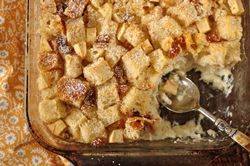
Bread Pudding
is an old fashioned dessert that had its humble beginnings in 13th century
England. It was first known as a "poor man's pudding" as it was made from
stale leftover bread that was simply moistened in water, to which a
little sugar, spices and other ingredients
were added.
Fast forward to today and you will find that we still make our bread puddings
with bread but the breads we use are often made especially for this
dessert. The types are wide ranging; from brioche, challah, croissant,
and panettone, to French,
Italian and sometimes even raisin bread or scones. And unlike bread puddings of
the past, we now moisten the bread in a rich mixture (really a custard) of
cream, eggs, sugar, butter, vanilla extract, and spices. It is no longer a
poor man's pudding. It is now a rich, creamy,
decadent dessert that has made its way onto the dessert menus of many fine
restaurants.
To make a Bread Pudding the bread is first
cut into bit sized cubes and the choice of whether to remove the bread
crusts is yours. The cubes of bread are then placed in a 9 x 13 inch (23 x
33 cm) baking pan. Then we need to make the custard which is then poured
over the bread cubes. You can add chopped nuts, pieces of chocolate,
lemon or orange zest, a little alcohol,
candied, dried or even fresh fruits to the pudding for more flavor and texture.
The one thing to take note of, though, is that this pudding is baked in a
water bath. A
water bath starts
with a large
shallow pan (usually a roasting pan of some sort) that is big enough to hold a
smaller pan that is filled with
a delicate food. It is best to place a clean dish towel on the
bottom of the large roasting pan to prevent the
dish from moving about during baking. Once
you have placed the smaller dish inside the large roasting pan,
hot water is poured into the larger pan until it reaches about halfway
up the outside of the smaller dish containing the food. This is then
placed in a slow oven. We do this because a water bath prevents delicate
foods, like this bread pudding, from burning, drying out, or curdling
(when a milk or egg mixture separates into its liquid and solid components).
Just make sure to
occasionally check the water level during the baking time, adding more hot water
as necessary.
Bread
Pudding: Preheat oven to 300
degrees F (150 degrees C) and place rack in center of oven. Lightly grease
with butter, or spray with a non stick vegetable spray, a 9 x 13 x 2 inch (23 x
33 x 5 cm)
heatproof baking dish. Place the baking dish into a larger
roasting pan that has enough room around its sides to fill with water.
Place the bread cubes and fruit (if using) in the
baking dish.
Custard:
In an electric mixer (or with a hand mixer), beat the eggs and sugar on high
speed until thick and lemon colored (about 4-5 minutes) (when beater is raised
the batter will fall back into bowl in a slow ribbon). Beat in the vanilla
extract and ground cinnamon. Then beat in the melted and cooled butter and half
and half (light cream).
Assemble:
Carefully pour (or ladle) the prepared custard over the
bread cubes until completely covered. Press down the bread cubes so they are covered with
the custard.
Prepare a
water bath. (A water bath is used to provide temperature protection for the egg custard.) Carefully pour in enough hot water so that the water is halfway up
sides of the 9 x 13 inch baking pan. Bake about 1 hour or until toothpick inserted in the
center comes out clean. Another way to judge whether the pudding is
fully baked, is to gently press down on the center of the pudding. If any
custard comes up to the top, the pudding needs to be baked a little longer. Remove the bread pudding from the water bath and cool slightly before serving.
Can be served
warm or cold with a dusting of confectioners' sugar and a dollop of softly
whipped cream or vanilla ice cream.
Makes one 9 x 13
bread pudding (serves about 8 - 10 people)
8 -
10 cups of bread cubes, cut into bite sized
pieces
Note:
Breads to use - French, Broiche, Challah, Croissant, Italian,
and/or Panettone. The bread can be fresh or stale and crusts can be
left on or removed. You can also use day old scones.
Use of materials on
all pages on the domains Joyofbaking.com,
the Joyofbaking.com Facebook
Page, the
Joyofbaking1 YouTube
Channel and any emails sent from @joyofbaking.com
are
entirely at the risk of the user and their owner, iFood Media LLC
will not be responsible for any damages directly or indirectly resulting
from the use.
References
cited may include a link to purchase the referenced book or item on Amazon.com.
Joyofbaking.com receives a commission on any purchases resulting from these
links.
This
website and the contents are not endorsed or sponsored by the owner of the
"Joy of Cooking" series of books or its publisher Simon & Schuster, Inc.
and is not related to the "Joy the Baker" books and website.
Video icons by Asher.
Content in any form may
not be copied or used without written permission of Stephanie Jaworski,
Joyofbaking.com. Students and non profit educators may use content without
permission with proper credit.