|
Raspberry Preserves:
Place the frozen unsweetened raspberries and the sugar in a small saucepan and
bring to a boil over medium heat. Reduce the heat and simmer, stirring
occasionally, for about 15 to 20 minutes or until most of the liquid has
evaporated. Do not let it burn. Remove from heat and pour into a heatproof measuring cup. Add a drop
or two of lemon juice. Cover and place in the refrigerator while you make
the crust. (The raspberry preserves can be made several days in advance. Cover
and store in the refrigerator.)
Linzer Torte: Preheat the oven to 350 degrees
F (177 degrees C) and position rack in the center of the oven. Place the almonds on a baking sheet
and bake for about 8 - 10 minutes or until lightly browned and
fragrant. Then place the hazelnuts on a baking sheet and bake for 15 minutes
or until fragrant and the outer skins begin to
flake and crack.
Remove from oven and place on wire rack to cool. Once the
almonds and hazelnuts have
cooled, place in a food processor and process, along with 1/2 cup (65 grams) of
flour, until finely ground. Add the remaining flour, sugar, lemon
zest, ground cinnamon, ground cloves, salt, and baking powder and process until
evenly combined. Add the butter and pulse until the mixture looks like
fine crumbs. Add the 2 egg yolks and vanilla extract and pulse until the
dough just begins to come together.
Gather the dough into a
ball and then divide it into two pieces, one slightly larger than the other.
Wrap the smaller ball of dough in plastic wrap and refrigerate for about an
hour, or until firm enough to roll. Take the larger
ball of dough and press it onto the bottom and up the sides of a buttered 9-10 inch
(23-25 cm) tart pan or springform pan. If using a springform pan press the
dough about 1 inch (2.5 cm) up the sides of the pan.
Take the cooled raspberry
preserves and spread them over the bottom of the crust. Cover with plastic
wrap and place in the refrigerator. Once the smaller
ball of dough is firm, remove from the fridge and roll it between two sheets of wax paper into a
circle that is about 12 inches (30 cm) in diameter. Using a pastry wheel or pizza
cutter, cut the pastry into 1 inch (2.5 cm) strips. Place
the strips of pastry on a parchment paper-lined baking sheet, cover with plastic
wrap, and place in the refrigerator for about 10 minutes. When strips are
firm, using an offset spatula, gently transfer the strips to
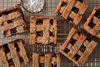
the tart pan. Lay half the strips, evenly spaced, across the
torte and then turn the pan a quarter turn and lay the remaining strips
across the first strips. If desired, weave the top strips over and under the
bottom strips. (Do not worry if the pastry tears, just press it back together as
best as you can.) Trim the edges of the strips to fit the tart pan.
If you have any leftover scraps of
dough, roll them into a long rope. Don't worry if
the rope breaks. Just take the pieces of rope and place them around the
outer edge of the tart where the ends of the lattice strips meets the bottom
crust. Using a fork or your fingers, press the rope into the edges of the bottom crust to
seal the edges.
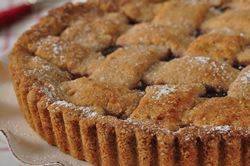
Bake the tart in a preheated
350 degree F (177 degree C) oven for about 30 - 35 minutes or until the pastry
is golden brown and set. Let the torte cool on a wire rack before unmolding.
Although you can serve this torte the same day as it is baked I like to cover
and store it overnight before serving. This torte is lovely
served warm with a dollop of whipped cream. Dust the top of the torte with
confectioners' sugar.
This torte will keep
for a few days at room temperature or in the
refrigerator for about a week. It can also be frozen.
Serves 8.
|