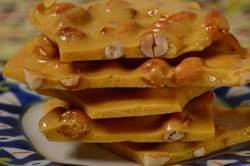
I've always loved Peanut Brittle. For
me, Peanut Brittle is a tie to the past; an old fashioned candy that
appeared in our house only during the Christmas season. I remember how it
came in a small cardboard box wrapped in cellophane that I couldn't wait to
open. I think the appeal of Peanut Brittle is how its shiny and hard surface
belies how easily the sugary brittle dissolves on the tongue, leaving behind delicious chunks
of toasted peanuts to chew on and savor.
Peanut Brittle has
a sweet and buttery flavor with a hard and crunchy texture. It uses the
most basic of ingredients (sugar, corn syrup, and peanuts). What's important to know is that
the corn syrup controls the grain of the brittle so adding too little and
you have a grainy textured brittle, while adding too much will result in a
stringy and sticky brittle.
To
start this Peanut Brittle, the water, corn syrup, sugar, raw peanuts, and
salt are brought to a boil. Because the peanuts are raw they are added at the beginning
so they have time to cook and impart a nice peanut flavor to the sugar mixture. Some recipes call for
adding roasted peanuts and if you want to do this, simply add the peanuts,
not at the beginning, but rather when the syrup reaches about 245 degrees F (118
degrees C). Brittles are cooked to a very high temperature, the 'hard crack' stage (296 degrees F,
147 degrees C). You will need to stir the sugar mixture occasionally to
prevent the peanuts from sticking to the bottom of the pan, and thereby scorching. When the brittle reaches the desired temperature, remove from heat,
and carefully add the baking soda, vanilla extract, and butter. The
brittle will immediately puff up but just keep stirring until everything
is mixed together. Baking soda is added as it helps with browning plus it gives the brittle a lighter and
crunchier texture. Butter and vanilla are added for flavor. The
brittle is then poured onto a cookie sheet and if you want a thin brittle,
then while the brittle is still very hot, use two forks to stretch the
brittle to how thin you want it.
Peanut
Brittle: Lightly butter a large baking sheet.
Have ready the baking soda, vanilla extract, and butter. Set
aside.
In a medium
sized saucepan over medium high heat, bring the water, corn syrup, sugar, salt,
and peanuts to a boil, stirring constantly with a wooden spoon or heatproof
spatula. Cover the saucepan
with a lid for about one minute to allow the sides of the pan to wash themselves
down and dissolve any sugar crystals. Then remove lid and clamp a
candy thermometer to the side of the pan, making sure it does not touch the
bottom of the pan. Cook until the syrup reaches 296
degrees F (147 degrees C) (hard crack stage), stirring occasionally to prevent the peanuts from
sticking to the bottom of the pan,
Remove from
heat and immediately stir in the baking soda, vanilla extract, and butter (the brittle will
puff up) stirring until everything is mixed together (about 30 seconds).
Immediately pour the brittle onto your baking sheet. If you want a thin brittle, then while
the brittle is still very hot, use two forks to stretch the brittle. Do this by gently pulling the brittle, working your way around the entire mass. Let the brittle completely
cool and then break into pieces. Store in an airtight container or a plastic
freezer bag as this will prevent the brittle from becoming sticky and breaking
down. Store at room temperature or in the refrigerator for up to two weeks.
This recipe can be
doubled.
Makes about 1
pound (450 grams). Preparation time 30 minutes.
Peanut Brittle:
1
teaspoon (4 grams) baking soda
1/2 teaspoon
pure vanilla extract
1/2
tablespoon (7 grams) butter, cut into small pieces
Use of materials on
all pages on the domains Joyofbaking.com,
the Joyofbaking.com Facebook
Page, the
Joyofbaking1 YouTube
Channel and any emails sent from @joyofbaking.com
are
entirely at the risk of the user and their owner, iFood Media LLC
will not be responsible for any damages directly or indirectly resulting
from the use.
References
cited may include a link to purchase the referenced book or item on Amazon.com.
Joyofbaking.com receives a commission on any purchases resulting from these
links.
This
website and the contents are not endorsed or sponsored by the owner of the
"Joy of Cooking" series of books or its publisher Simon & Schuster, Inc.
and is not related to the "Joy the Baker" books and website.
Video icons by Asher.
Content in any form may
not be copied or used without written permission of Stephanie Jaworski,
Joyofbaking.com. Students and non profit educators may use content without
permission with proper credit.