It's
funny how something can go unnoticed for years and then suddenly you see it
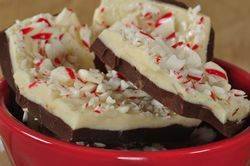
everywhere. That is how it was for me with Peppermint Bark; that
beautiful confection of dark and white chocolate covered with crushed candy canes.
The only problem I have with commercially made Peppermint Bark is that it is very
expensive. Luckily we can make it at home as it is much easier to
make than it looks. Only three ingredients are required, dark chocolate, white chocolate, and
candy canes.
The difference between commercially made Peppermint Bark and homemade
is how the chocolate is handled. Commercially made
Peppermint Bark uses tempered chocolate which keeps the chocolate shiny
and hard, even when stored at room temperature. Since most of us are a
little hesitant about tempering, this homemade Peppermint Bark recipe
omits that step. Instead, a little vegetable oil is added to the melted
chocolate which will keep it nice and shiny, and it will still have that
wonderful 'snap' when you break it into pieces. It does, however, need to
be stored in the refrigerator.
If you have spent any time on the site you know I often talk about how
the brand of
chocolate you use will affect the flavor of what you are making. So, as
always, choose
your chocolate carefully. There are many good brands of dark and white chocolate on
the market, both foreign and domestic. Just be sure to taste the chocolate
first as not all chocolates are the same. Some popular brands of dark
chocolate
are: Ghirardelli, Guittard, Lindt, Perugina, Scharffen
Berger, Callebaut, and Valrhona. When choosing white chocolate, always check the
label to make sure the chocolate contains cocoa butter. White chocolate
needs cocoa butter to give it that sweet yet mellow flavor and smooth and
creamy texture. Inferior brands use vegetable fat in place of the cocoa
butter and their flavor ends up being very sweet and artificial tasting.
Some brands
of white chocolate are Lindt, Ghirardelli, Callebaut and even Baker's
(found in grocery stores).
Peppermint
Bark: Line the bottom and sides of an 8 inch (20 cm) square baking pan with
aluminum foil, smoothing out any wrinkles.
Melt the semi
sweet chocolate with 1 teaspoon of vegetable oil in a heatproof bowl placed over a
saucepan of simmering water. Immediately pour the melted chocolate into the
prepared pan and tilt the pan so the chocolate makes an even layer. Place in the
refrigerator for about 30 minutes, or until the chocolate has set.
Then, melt the
white chocolate with the remaining 1 teaspoon of vegetable oil in a heatproof bowl
placed over a saucepan of simmering water. Immediately pour the melted white chocolate
over the dark chocolate and tilt the pan so the chocolate is in an even layer.
Sprinkle the crushed candy canes evenly over the white chocolate. Place in
the refrigerator for about 30 minutes, or until the chocolate has set.
Remove the
Peppermint Bark from the pan by lifting the edges of the aluminum foil. Peel
back the foil and break, or cut,
the bark into small irregular pieces. Store in an airtight container in the
refrigerator for up to two weeks.
Makes about 25
pieces. Preparation time 45 minutes.
Use of materials on
all pages on the domains Joyofbaking.com,
the Joyofbaking.com Facebook
Page, the
Joyofbaking1 YouTube
Channel and any emails sent from @joyofbaking.com
are
entirely at the risk of the user and their owner, iFood Media LLC
will not be responsible for any damages directly or indirectly resulting
from the use.
References
cited may include a link to purchase the referenced book or item on Amazon.com.
Joyofbaking.com receives a commission on any purchases resulting from these
links.
This
website and the contents are not endorsed or sponsored by the owner of the
"Joy of Cooking" series of books or its publisher Simon & Schuster, Inc.
and is not related to the "Joy the Baker" books and website.
Video icons by Asher.
Content in any form may
not be copied or used without written permission of Stephanie Jaworski,
Joyofbaking.com. Students and non profit educators may use content without
permission with proper credit.