Page loading ... Please wait.
 
Baking & Dessert Recipes & Photos
 
Web Joyofbaking.com


About Us

Substitutions

Ingredients

Glossary

Conversions


Home

Recipe Index

New Recipes

Breakfast & Brunch

Bars & Squares

Cakes

Cookies

Comfort Foods

Pies & Tarts

Biscotti

Quick Breads

Muffins

Scones

Shortbreads

English Tea Party

Trifles

Apple Recipes

Lemon Recipes

Strawberry Recipes

Christmas Baking

Christmas Candy

Christmas Cookies

Valentine's Day Desserts

Thanksgiving Baking

Easter Baking

Ice Creams & Ices

Baking History

Bibliography

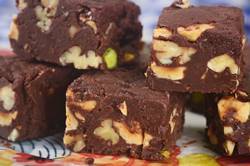
Simple Chocolate Fudge Recipe

Printer Friendly Page

Fudge making has been popular in North America for over a century. Young women on college campuses in the 1890s are credited with its invention and there are many theories as to why it was called 'fudge'. Andrew F. Smith in "The Oxford Companion to American Food and Drink" suggests the name "refers to an expression young women might have used instead of swearing". I guess it doesn't really matter how it became known as fudge, only that it quickly became popular and by the 1900s it was commonly found in candy stores, especially at summer resorts. 

Now, if you find the old fashioned method of making fudge daunting, you are not alone. The boiling of a sugar syrup has a tendency to be temperamental and success and failure are never far apart. Luckily, fudge recipes have now been developed to side step the boiling of this sugar syrup. This is possible by using sweetened condensed milk which is a ready made concentrated sugar syrup. It is made from a mixture of whole milk and sugar that has had about 60 percent of its water removed. Its consistency is thick and sticky (like honey) and it is very sweet tasting. To give you a small bit of history, condensed milk was the result of Gail Borden's (1801-1874) determination to invent a milk that could be stored and distributed over long distances. At the time of its invention (1856) milk was not pasteurized so it was difficult to keep it fresh and free of germs. After Borden received a patent on his invention he starting producing condensed milk, but it wasn't until it became standard issue for the troops during the Civil War that it really gained popularity

So, lets begin. This recipe is so easy. All you need to do is heat the sweetened condensed milk with the chocolate and butter in a heatproof bowl over a saucepan of simmering water until the chocolate has melted and the fudge is smooth. Then remove from heat, add the vanilla extract and nuts, and spread into your pan. Your done. It is important to use a good chocolate that you enjoy eating out of hand. There are many good brands of chocolate on the market today, both foreign and domestic. Taste the chocolate before using as not all chocolates are the same. Although the professionals swear by the high end bittersweet chocolates, these are not for everyone as their taste can be too bitter for some palates. So keep this in mind when giving fudge as gifts or when serving to children. Some popular brands of chocolate are: Baker's, Callebaut, Cocao Barry, El Rey, Ghirardelli, Guittard, Hersheys, Lindt, Nestle, Perugina, Scharffen Berger, and Valrhona


To toast nuts:  Preheat oven to 350 degrees F (177 degrees C) and place rack in center of oven. Place the hazelnuts on a baking sheet and bake for about 15 minutes or until the nuts are fragrant and their skins start to blister. Remove from oven and place in a clean kitchen towel. Roll up the towel and let the nuts steam for five minutes and then rub nuts to remove skins. Let cool and then chop into pieces.

If using pecans or walnuts toast the nuts for about 8 minutes, or until lightly brown and fragrant. Cool and then chop coarsely.

Chocolate Fudge: First line the bottom and sides of an 8 x 8 x 2 inch pan (20 x 20 x 5 cm) with aluminum foil. Set aside.

Combine the condensed milk, chopped chocolate, and butter in a stainless steel bowl and place over a saucepan of simmering water. Melt the chocolate mixture, stirring frequently, making sure the mixture doesn't get too hot or the fudge may be grainy. Stir until smooth (it will be very thick). Remove from heat and stir in the vanilla extract and chopped nuts. Spread the fudge into the prepared pan, smoothing the top with an offset spatula. Let stand at room temperature until cool. Then carefully remove the fudge from the pan by lifting the edges of the foil. With a long, sharp knife cut the fudge into pieces. Store in the refrigerator for several days or freeze, well wrapped, for several months. Let thaw at room temperature, unwrapped, for a few hours before serving.

Chocolate Fudge:

1 1/2 cups (150 grams) hazelnuts, toasted, skinned, and chopped (can also use pecans or walnuts, toasted and roughly chopped)

1-14 ounce can (396 grams) sweetened condensed milk

1 pound (452 grams) bittersweet or semisweet chocolate, coarsely chopped

2 tablespoons (28 grams) unsalted butter

2 teaspoons pure vanilla extract

Sources

Corriher, Shirley O. Cookwise. New York: William Morrow and Company, Inc., 1997.

Davidson, Alan. The Oxford Companion to Food. Oxford: Oxford University Press, 1999.

Heatter, Maida. Maida Heatter's Cookies. New York: Cader Books, 1997.

Luchetti, Emily. Four-Star Desserts. New York; Harper Collins Publishers, 1996.

Willan, Anne. LaVarenne Pratique. New York: Crown Publishers, Inc., 1989.

s


Save This Page to del.icio.us


A baking resource on the Internet since 1997

Contact Us   Privacy Policy

All content on this site is either original or has been significantly modified and changed from its credited original source.  Use of materials on Joyofbaking.com is entirely at the risk of the user and Joyofbaking.com or Stephanie Jaworski will not be responsible for any damages directly or indirectly resulting from the use.

This website and the contents thereof are not endorsed or sponsored by the owner of the "Joy of Cooking" series of books or its publisher Simon & Schuster, Inc.

Content in any form may not be copied or used without written permission of Stephanie Jaworski, Joyofbaking.com.  Students and non profit educators may use content without permission with proper credit. 

Copyright  1997 to 2008 Stephanie Jaworski