Page loading ... Please wait.
 
Baking & Dessert Recipes & Photos
 
Web Joyofbaking.com


About Us

Substitutions

Ingredients

Glossary

Conversions


Home

Recipe Index

New Recipes

Breakfast & Brunch

Bars & Squares

Cakes

Cookies

Comfort Foods

Pies & Tarts

Biscotti

Quick Breads

Muffins

Scones

Shortbreads

English Tea Party

Trifles

Apple Recipes

Lemon Recipes

Strawberry Recipes

Christmas Baking

Christmas Candy

Christmas Cookies

Valentine's Day Desserts

Thanksgiving Baking

Easter Baking

Ice Creams & Ices

Baking History

Bibliography

Chocolate Ice Cream Recipe

Printer Friendly Page

Chocolate Ice Cream Recipe

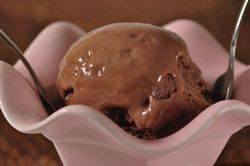
If you are a chocolate lover, you will not be surprised to hear that chocolate ice cream is an American favorite. This ice cream is wonderfully rich and chocolately, as it contains both cocoa powder and semisweet chocolate and its silky smooth texture comes from using a custard base.

Ice creams that start with a custard are made from cream, sugar, eggs, and flavoring. Each ingredient contributes to the ice cream's smooth texture and rich flavor. The amount of cream used and its butterfat content gives ice cream its rich and creamy taste. The next ingredient, sugar, gives the ice cream its smoothness. The eggs are necessary for smoothness and also gives the ice cream its nice color. The best results come when the custard is made the the night before and left in the refrigerator overnight to chill sufficiently before it is churned. It is important that the custard only fills your ice cream machine about half to two thirds full. This gives the custard enough room to expand while it freezes so you end up with an ice cream with a light texture and no graininess. As the ice cream is still quite soft once it has been churned in the machine, transfer it to a storage container and place it in the freezer for a few hours before serving. This also allows the flavors to mellow. Although I prefer to eat homemade ice cream the day it is made, it can be stored for a few weeks in the freezer. It will become quite hard after being frozen for any length of time so transfer it to the refrigerator to soften for about 30 minutes before serving.

As this recipe only uses egg yolks, there is always the question of what to do with the leftover egg whites. Meringues (Meringue Cookies, Meringue Hearts, Meringue Mushrooms, Pavlova) are always a good way to use egg whites as is the Chocolate Angel Food Cake.

 
In a small saucepan gradually whisk together the half and half and the cocoa powder until it is a smooth paste.  Place over medium-high heat and bring the half-and-half cocoa mixture and the vanilla bean (if using) to the scalding point (the milk begins to foam up). Remove from heat, take out the vanilla bean and scrape the seeds from the bean with the back of a knife, and mix the seeds back into the half-and-half. Add the chopped chocolate and stir until the chocolate has completely melted and is smooth.

Meanwhile in a stainless steel bowl beat the egg yolks and sugar until light and fluffy (about two minutes). You can do this with a wire whisk or I like to use a hand mixer. Gradually pour the scalding half-and-half mixture into the whipped egg yolk mixture, making sure you keep whisking constantly so the eggs don't curdle. If any lumps do form, strain the mixture first before heating.

Place the bowl over a saucepan of simmering water and, stirring constantly with a wooden spoon, cook until the custard thickens enough that it coats the back of a spoon (170 degrees F) (77 degrees C). The term 'coat a spoon' is a technique used mainly as a way to test when an egg-based custard or sauce is done. A spoon, usually wooden, is placed in the custard and, when the spoon is raised, the film of custard on the back of the spoon will stay in place even when you draw a line with your finger through the middle of the custard. 

Immediately remove the custard from the heat and continue to stir the custard for a few minutes so it does not overcook. At this point stir in the vanilla extract, if using. Cover and let cool to room temperature and then refrigerate the custard until it is completely cold (several hours but preferably overnight). 

Transfer the cold custard to the container of your ice cream machine and process according to the manufacturer's instructions. Once made, transfer the ice cream to a chilled container and store in the freezer. If the ice cream becomes too hard place in the refrigerator for about 30 minutes before serving so it can soften.


Recipe:

2 cups (480 ml) half-and-half

1/3 cup plus 2 tablespoons (50 grams) unsweetened cocoa powder

1/2 vanilla bean or 1 1/2 teaspoons pure vanilla extract

2 ounces (55 grams) semisweet chocolate, chopped

4 large egg yolks

1/2 cup (100 grams) granulated white sugar

Note:  Half and Half cream is a mixture of cream and whole milk and contains 10 ½ - 12% butterfat.


Sources

Andrews, Tamra, Nectar and Ambrosia: An Encyclopedia of Food in World Mythology. Santa Barbara: ABC-CLIO, Inc., 2000.

Dickson, Paul. The Great American Ice Cream Book. New York: Galahad Books, 1972.

Friberg, Bo.  The Professional Pastry Chef (Third Edition). New York: Van Nostrand Reinhold, 1996.

Liddell, Caroline and Weir, Robin. Frozen Desserts. New York: St. Martin's Griffin: 1995.

Visser, Margaret. Much Depends on Dinner. New York: Grove Press, 1986.


s


Save This Page to del.icio.us


A baking resource on the Internet since 1997

Contact Us   Privacy Policy

All content on this site is either original or has been significantly modified and changed from its credited original source.  Use of materials on Joyofbaking.com is entirely at the risk of the user and Joyofbaking.com or Stephanie Jaworski will not be responsible for any damages directly or indirectly resulting from the use.

This website and the contents thereof are not endorsed or sponsored by the owner of the "Joy of Cooking" series of books or its publisher Simon & Schuster, Inc.

Content in any form may not be copied or used without written permission of Stephanie Jaworski, Joyofbaking.com.  Students and non profit educators may use content without permission with proper credit. 

Copyright  1997 to 2008 Stephanie Jaworski