|
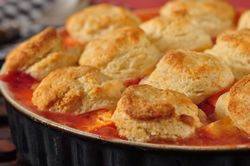
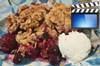
Peach Cobbler:
You will need a 9 inch (23 cm) round deep dish pie plate or an 8 x 8 x 2 inch
(20 x 20 x 5 cm) oven proof baking dish. Place the baking dish on a large baking
sheet to catch any drips.
To remove the
outer skins of the peaches, first dip them into a large pot of boiling water for about 30 -
90 seconds,
depending on their ripeness. Then immediately transfer the peaches to a large bowl of
ice water (this stops the cooking process). Let cool for a few minutes and then
the skins should slip easily off
the peaches. Cut the peaches in half, remove the stones, and cut the fruit into
thick wedges. Place the wedges in a large bowl and toss with the
lemon juice to stop discoloration. Add the raspberries, if using.
In a small bowl,
stir together the sugar, cornstarch, and ground cinnamon. Sprinkle this mixture
over the fruit and toss gently to combine. Pour the mixture into your pie plate.
Then preheat your oven to 375 degrees F
(190 degrees C) and place rack in the center of the oven.
Biscuit Dough:
In a large bowl, whisk together
the flour, sugar, baking powder and salt. Cut the butter into small pieces and
blend into the flour mixture with a pastry blender, two knives, or your
fingertips. The mixture
should look like coarse crumbs. Add the milk to the flour mixture. Stir
just until combined. Do not over mix.
Knead
the
dough gently on a lightly floured surface and then roll or pat the dough into a circle
that is about 1/2 inch (1.5 cm) thick. Then, using a 2 inch (5 cm)
round cookie cutter, cut the dough into rounds. Place the rounds on top
of the fruit. Brush the tops of the biscuits with a little cream.
Bake for
approximately 30 - 40 minutes or until the fruit
juices are bubbling and the biscuits are
golden brown and a toothpick inserted into a biscuit comes out clean. (If the
biscuits are getting too brown during baking, and before the fruit juices are bubbling,
cover loosely with a piece of foil.) Remove from oven and place on a wire rack
to cool slightly before serving.
Serve with softly
whipped cream or vanilla ice cream. Refrigerate leftovers and reheat
before serving.
Makes about 6
- 8 servings.
View comments on this recipe on YouTube
References:
Bloom, Carole.
The International Dictionary of Desserts, Pastries, and Confections.
New York: Hearst Books, 1995.
Editors of Cook's
Illustrated. Baking Illustrated. America's Test Kitchen. Brookline MA:
2004.
Friberg, Bo.
The Professional Pastry Chef (Third Edition). New York: Van
Nostrand Reinhold, 1996.
Mariani, John F.
The Dictionary of American Food & Drink, New Haven and New York:
Ticknor & Fields, 1983.
The Moosewood Collective.
Moosewood Restaurant Book of Desserts. Clarkson Potter/Publishers. New York:
1997.
Rombauer, Irma
S., Rombauer Becker, Marion & Becker, Ethan. The Joy of Cooking.
New York: Scribner, 1997.
Sax, Richard.
Classic Home Desserts. Houghton Mifflin Company. New York: 1994.
|