Page loading ... Please wait.
Baking & Dessert Recipes & Pictures

breakfast & brunch bars & squares biscotti recipes shortbread recipes comfort foods healthy baking
about us
thanksgiving baking
substitutions
ingredients
glossary
conversions
christmas baking
christmas cookies
christmas candy
english tea party
quick breads
chocolate recipes
pumpkin recipes
apple recipes
cranberry recipes
blueberry recipes
lemon recipes
strawberry recipes
trifle recipes
ice cream recipes
pudding recipes
easter baking
valentine's baking
halloween baking
baking history
bibliography

Peach Pie Recipe

Printer Friendly Page

Peach Pie Recipe

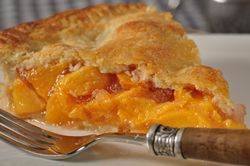
Peaches need care in their growing, their storage, their transportation, and in their baking. Bakers may not be able to control how peaches are grown, stored, or transported, but they can control how they are cooked. My three favorite ways to cook peaches are in a Peach Cobbler, a Peach Tart, and this lovely Peach Pie. All three of these recipes combine some type of pastry with fresh peaches that are sliced and lightly sweetened. For this peach pie we take two layers of buttery crisp pastry and put lightly sweetened slices of fresh peaches in between. What I like about this summery dessert is that it highlights the peach's flavor, sweet yet with a touch of tanginess. The other ingredients added to the peach filling are there only to enhance the peach, sugar for sweetness, a splash of lemon juice to keep the peaches from discoloring, a pinch of salt, a dab of butter, and a few tablespoons of tapioca to thicken the peach's sweet juices. What could be more perfect on a warm summer's night than a slice of this pie with a scoop of vanilla ice cream? 


The two important components in fruit pies, are a crust with good flavor and texture, and excellent tasting fruit. For me, nothing beats Pate Brisee (a short crust pastry) that is made from a mixture of flour, sugar, salt, cold unsalted butter, and ice water. It has a high ratio of fat to flour which gives the pastry its crisp and crumbly texture and buttery flavor. It is easily made in your food processor and is quite easy to handle. Just be sure to flour both your work surface and rolling pin to prevent the pastry from sticking, and keep turning the pastry as you roll it out so it has uniform thickness.

As I said above, a fruit pie must also start with good quality fruit. The first thing you need to know is that there are two types of peaches, 'Clingstone' and 'Freestone', with many varieties within each classification. The names (Clingstone and Freestone) refer to how easily the flesh of the peach separates from its stone. The Clingstone (available in late spring/early summer), is exactly that, the flesh clings stubbornly to the central stone or pit. Freestones (available late summer) have a flesh that is easily separated from the stone, which makes it my personal preference. When buying peaches, smell and feel each peach. The peach should smell like a peach and feel firm, yet have a slight give when you press gently on its shoulders. Make sure there are no bruises, cuts, or soft patches on the peaches. The amount of red blush on a peach is a sign of its variety, not its ripeness.  Peaches will not ripen or become sweeter after they are picked but they will soften and become juicier in a day or two if left at room temperature. Once ripe, they can be stored in the refrigerator for a couple of days.


Pate Brisee:  In a food processor, place the flour, salt, and sugar and process until combined.  Add the butter and process until the mixture resembles coarse meal (about 15 seconds). Pour 1/4 cup (60 ml) ice water in a slow, steady stream, through the feed tube until the dough just holds together when pinched. If necessary, add more water. Do not process for more than 30 seconds.

Turn the dough onto your work surface and gather into a ball. Divide the dough in half, flattening each half into a disk, cover with plastic wrap, and refrigerate for about one hour before using. This will chill the butter and relax the gluten in the flour. 

Peach Filling:  Meanwhile, dip the peaches into a large pot of boiling water for about 30 - 60 seconds, depending on the ripeness of each peach. Transfer the fruit to a large bowl of ice water (this stops the cooking process). The skins should now slip easily off the peaches. Cut the peaches in half, remove the stones, and cut the fruit into slices. Place the peach slices in a large bowl and toss with the sugar, tapioca, lemon juice, salt, and butter. Cover the bowl with plastic wrap and let stand, at room temperature, for about 30 minutes so the peaches have time to release their juices, the sugar can dissolve, and the tapioca becomes nice and plump.

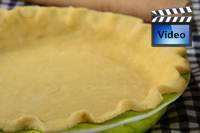
After the dough has chilled sufficiently, remove one portion of the dough from the fridge and place it on a lightly floured surface. Roll the pastry into a 12 inch (30 cm) circle. (To prevent the pastry from sticking to the counter and to ensure uniform thickness, keep lifting up and turning the pastry a quarter turn as you roll (always roll from the center of the pastry outwards).) Fold the dough in half and gently transfer to a 9 inch (23 cm) pie pan. Brush off any excess flour and tuck the overhanging pastry under itself, crimping as desired. Refrigerate the pastry, covered with plastic wrap, while you roll out the second round of pastry.

Remove the second round of pastry from the refrigerator and roll it into a 12 inch (30 cm) circle. Transfer to a parchment lined baking sheet, cover with plastic wrap, and place in the refrigerator. 

Preheat the oven to 400 degrees F (205 degrees C) and place the oven rack in the lower third of the oven.

Remove the pie crust from the refrigerator and gently pour the peach filling into the chilled pie crust. Moisten the edges of the pie shell with a little water and then place the top crust over the peaches. Tuck any excess pastry under the bottom crust and then crimp the edges using your fingers or a fork. Using a sharp knife, make 3 - 2-inch (5 cm) slits from the center of the pie out towards the edge of the pie to allow the steam to escape. Lightly brush the top crust with cream and sprinkle with a little granulated white sugar.

Bake the pie for about 45 - 60 minutes or until the crust is a deep golden brown color and the juices are bubbling and thick. If the edges of the pie are browning too much during baking, cover with a foil ring. 

Place the baked pie on a wire rack to cool for an hour. Serve at room temperature with softly whipped cream or vanilla ice cream. Leftovers can be stored for a couple of days at room temperature or in the refrigerator.

Makes one 9 inch (23 cm) pie.

Sources:

Beranbaum, Rose Levy. 'The Pie and Pastry Bible'. Scribner. New York: 1998.

Daley, Regan. in the sweet kitchen. Random House Canada. Toronto: 2000.

Waters, Alice. Chez Panisse Fruit. Harper Collins Publishers. New York: 2002.

Pate Brisee (Short Crust Pastry):

2 1/2 cups (350 grams) all-purpose flour

1 teaspoon salt

2 tablespoon (30 grams) granulated white sugar

1 cup (226 grams) unsalted butter, chilled, and cut into 1 inch (2.54 cm) pieces

1/4 to 1/2 cup (60 - 120 ml) ice water

Peach Filling:

6 cups (2 1/2 pounds) (1.1 kg) fresh peaches

1/4 cup (50 grams) granulated white sugar

3 tablespoons (35 grams) quick cooking tapioca

2 teaspoons fresh lemon juice

1/8 teaspoon salt

1 tablespoon (12 grams) unsalted butter, cut into small pieces

Garnish:

1 tablespoon cream or milk

Granulated white sugar


Bookmark and Share

Join Our New & Featured Recipes Email List

New Recipes


Top 40 Recipes of the Last Year*

*Top 40 Recipes based on actual site traffic from October 1, 2008  to September 30, 2009.


Contact Us   Privacy Policy Follow Joyofbaking On Twitter

Arabic Mandarin Dutch French German Hindi Indonesian Italian Japanese Korean Norwegian Portuguese Russian Spanish Greek Swedish Finnish

Use of materials on Joyofbaking.com is entirely at the risk of the user and Joyofbaking.com, Stephanie Jaworski or Rick Jaworski will not be responsible for any damages directly or indirectly resulting from the use.

This website and the contents are not endorsed or sponsored by the owner of the "Joy of Cooking" series of books or its publisher Simon & Schuster, Inc.

Content in any form may not be copied or used without written permission of Stephanie Jaworski, Joyofbaking.com.  Students and non profit educators may use content without permission with proper credit. 

A baking resource on the Internet since 1997

Copyright  1997 to 2009 Stephanie & Rick Jaworski