Page loading ... Please wait.
Baking & Dessert Recipes & Pictures

breakfast & brunch bars & squares biscotti recipes shortbread recipes comfort foods healthy baking
about us
thanksgiving baking
substitutions
ingredients
glossary
conversions
christmas baking
christmas cookies
christmas candy
english tea party
quick breads
chocolate recipes
pumpkin recipes
apple recipes
cranberry recipes
blueberry recipes
lemon recipes
strawberry recipes
trifle recipes
ice cream recipes
pudding recipes
easter baking
valentine's baking
halloween baking
baking history
bibliography

Scones Topped With Preserves Recipe

Printer Friendly Page

Scones Topped With Preserves Recipe

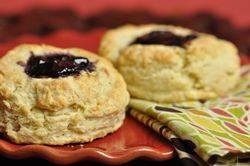
Scones and jam go so well together that it was only a matter of time before we started to add the jam to the scones before, not after, they are baked. There are two ways to do this and I have recipes on the site for both; one is to sandwich the jam in the middle of each scone (Scones filled with Jam) and the other is to place a dollop of jam right on the top of each scone (done here). There is no rule as to what flavor of jam or preserve you must use, only that it be of good quality. If you are confused about the difference between jam and preserves, don't be. They are both a cooked combination of fruit and sugar (and sometimes pectin) and the only difference is that preserves still contain chunks of fruit, whereas jam is more like a fruit puree. For the scones, we are going to make

them with buttermilk, instead of milk, which gives us a tender bread-like not cake-like scone. Buttermilk has a nice thick creamy texture with a rich tangy buttery taste and in the past it was the liquid left over after churning butter. Today it is commercially made by adding a bacteria to whole, skim, or low fat milk. If you do not want to buy it you can use buttermilk powder or else make your own by adding 1 tablespoon of white distilled vinegar, cider vinegar, or lemon juice to 1 cup of milk and then let it stand 5 to 10 minutes before using.

These scones are baked at a higher than normal oven temperature to give them a dark, crisp crust. If you find that the bottoms of the scones get too brown you can use two baking sheets (place one pan inside another) to stop this from happening..  Immediately after baking the scones are dusted with powdered sugar and placed under the broiler to give them more color and a nice crisp crust. 


Preheat oven to 400 degrees F (200 degrees C) and place rack in middle of oven.  Stack two baking sheets together and line the top baking sheet with parchment paper. (This prevents the bottoms of the scones from over browning during baking.)

In a large bowl, whisk together the flour, sugar, baking powder, baking soda, and salt. Cut the butter into small pieces and blend into the flour mixture with a pastry blender or two knives. The mixture should look like coarse crumbs.    In a small measuring cup combine the buttermilk and vanilla extract. Add the buttermilk mixture to the flour mixture (adding more buttermilk if necessary) and stir just until the dough comes together. Do not over mix the dough.

Transfer to a lightly floured surface and knead dough gently four or five times and then pat the dough into a circle that is about 7 inches (18 cm) round and about 11/2 inches (3.75 cm) thick. Cut this circle in half, then cut each half into 4 pie-shaped wedges (triangles).  Place the scones on the baking sheet.  In the middle of each scone make an small indentation, about 3/4 inch (2 cm) in diameter (with your finger or the end of a floured wooden spoon) for the preserves. Make an egg wash of one well-beaten egg mixed with 1 tablespoon milk and brush the tops of the scones with this mixture. Fill each indentation with about 1/2 teaspoon jam or preserves.

Bake for about 18 - 20 minutes or until golden brown and a toothpick inserted in the middle comes out clean. Remove from oven and then turn your broiler on high. Sift confectioners (powdered or icing) sugar heavily over the tops of the scones and place them under the broiler. Broil for just a few seconds, turning the pan as necessary, until the sugar has melted and turns golden brown. Make sure to watch the scones carefully as the sugar will burn very quickly.   Transfer to a wire rack to cool.

Makes 8 scones.

Recipe:

2 cups (280 grams) all purpose flour

1/4 cup (50 grams) granulated white sugar

1 teaspoon baking powder

1/4 teaspoon baking soda

1/4 teaspoon salt

1/2 cup (113 grams) (1 stick) unsalted butter, cold and cut into pieces

2/3 cup (160 ml) buttermilk

1 teaspoon pure vanilla extract

Jam or Preserves

Egg mixture for brushing tops of scones:

1 large egg, lightly beaten

1 tablespoon milk or cream

Note:  Brushing the tops of the scones with the egg/cream mixture helps brown the tops of the scones.


Join Our New & Featured Recipes Email List

New Recipes


Top 40 Recipes of the Last Year*

*Top 40 Recipes based on actual site traffic from October 1, 2008  to September 30, 2009.


Contact Us   Privacy Policy Follow Joyofbaking On Twitter

Arabic Mandarin Dutch French German Hindi Indonesian Italian Japanese Korean Norwegian Portuguese Russian Spanish Greek Swedish Finnish

Use of materials on Joyofbaking.com is entirely at the risk of the user and Joyofbaking.com, Stephanie Jaworski or Rick Jaworski will not be responsible for any damages directly or indirectly resulting from the use.

This website and the contents are not endorsed or sponsored by the owner of the "Joy of Cooking" series of books or its publisher Simon & Schuster, Inc.

Content in any form may not be copied or used without written permission of Stephanie Jaworski, Joyofbaking.com.  Students and non profit educators may use content without permission with proper credit. 

A baking resource on the Internet since 1997

Copyright  1997 to 2009 Stephanie & Rick Jaworski