Soda Bread, as its name implies, gets its rise, not from yeast, but from baking soda (bicarbonate of soda).
Soda Bread is classified as a quick bread, and in its most basic form contains
only four ingredients, baking soda, flour (all purpose and/or whole wheat), salt, and buttermilk (or
soured milk). When raisins (currants or sultanas) and a little sugar are
added to the dough, its name changes from Soda Bread to Spotted Dick or Spotted Dog.
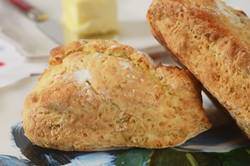
Irish Soda Scones have a golden brown crust that
is wonderfully crisp. Inside they are nice and soft. For this recipe I have
decided to make Scones instead of the usual round of bread. You can use All
Purpose White Flour, Whole Wheat Flour, or a combination of the two
flours.
Irish Soda Scones contain
buttermilk which has a nice thick creamy texture with a rich and
tangy buttery taste that makes these scones nice and tender.
Whereas in the past buttermilk was the liquid left over after churning butter, it is now
commercially made by adding a bacteria to whole, skim, or low fat milk. You can make
a good substitute for commercial buttermilk by
adding 1 1/2 tablespoons of white distilled vinegar, cider vinegar, or lemon juice to
1 1/2 cups (360 ml/grams) of milk. Let stand about 10 minutes at room temperature before using.
The Irish Soda Scones
are baked in a hot oven and this produces a scone with a hard and crusty
outer crust yet inside they have a soft and tender crumb. However, when
covered and stored overnight the crust will soften. Scones make a great
accompaniment to soups and stews or for breakfast eaten with butter and
jam.
Irish Soda
Scones: Preheat your oven to
425
degrees F (220 degrees C) and place the oven rack in the center of the oven. Line a baking
sheet with parchment paper.
In a large
bowl, whisk together the flour, sugar (if using), baking soda, and salt. Make a well in the
center of the flour mixture and add most of the buttermilk. Using one
hand, a wooden spoon or spatula, mix (adding more buttermilk if necessary) until you
have a soft and moist dough.
Transfer the dough to a lightly floured surface and
gently
knead the
dough into a 7 inch (18 cm) round. Cut this
circle into 6 triangular sections. Place the scones on your prepared
baking sheet and brush the tops with a little buttermilk or milk and then dust
with a little flour. This gives
the baked scones a floury brown crust.
Bake
for about 18 to 20 minutes or until nicely browned and a toothpick inserted into
the center of a scone comes out clean. Remove from oven and place on a wire rack. These scones are best
served warm from the oven with a little butter and jam.
Use of materials on
all pages on the domains Joyofbaking.com,
the Joyofbaking.com Facebook
Page, the
Joyofbaking1 YouTube
Channel and any emails sent from @joyofbaking.com
are
entirely at the risk of the user and their owner, iFood Media LLC
will not be responsible for any damages directly or indirectly resulting
from the use.
References
cited may include a link to purchase the referenced book or item on Amazon.com.
Joyofbaking.com receives a commission on any purchases resulting from these
links.
This
website and the contents are not endorsed or sponsored by the owner of the
"Joy of Cooking" series of books or its publisher Simon & Schuster, Inc.
and is not related to the "Joy the Baker" books and website.
Video icons by Asher.
Content in any form may
not be copied or used without written permission of Stephanie Jaworski,
Joyofbaking.com. Students and non profit educators may use content without
permission with proper credit.










.%20It%20can%20be%20made%20very%20quickly%20as%20it%20contains%20only%20four%20ingredients%3B%20baking%20soda%20along%20with%20flour%2C%20salt%2C%20and%20buttermilk.%20%20From%20Joyofbaking.com%20With%20Demo%20Video)