ur
patterns of eating often change with the seasons. The desserts that
are perfect in the middle of winter, somehow seem out of place during the
hot summer months. So what I often do on hot summer days is
make light and fruity gelatin based desserts. Take for example
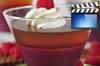
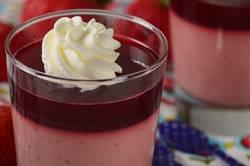
this beautiful parfait which combines a ruby red raspberry jelly with a
soft pink strawberry Bavarian cream.
While both layers start with sweetened fruit purees, the raspberry jelly
just adds unflavored gelatin to a raspberry puree, while the strawberry
cream first adds buttermilk to a strawberry puree and then sets this
mixture with unflavored gelatin. .
The important thing to remember when making any layered gelatin dessert is
that each layer must be allowed to set before you add the next layer. This
keeps each layer separate and prevents one layer from bleeding into the
other. For an elegant presentation, I often serve these parfaits in long
stem wine glasses, oftentimes with a dollop of softly whipped cream. You
can make this dessert a day before serving but keep them out of your
children's reach as they find them very hard to resist.
I know there is an ongoing
debate about whether leaf gelatin is better than powdered gelatin.
For practical purposes, though, I have used powdered gelatin as leaf
gelatin is hard to come by in North America, save ordering it. Powdered unflavored gelatin is sold in the baking section of grocery
stores and is packaged in small boxes which hold four paper envelopes of
powdered gelatin. Each 1/4 ounce (7 grams) (scant tablespoon)
envelope of gelatin will jell about 2 cups (480 ml) of liquid.
Unflavored gelatin is tiny granules that are tasteless, colorless, and
odorless. It is used as a thickening agent but only becomes active
when dissolved in hot water. To use gelatin you first need to
sprinkle it over a cold liquid so the gelatin softens, swells and becomes
spongy. The softened gelatin then needs to be warmed so the granules
completely dissolve and the proteins become activated. To check to
see if the gelatin has completely dissolved, dip a spoon into the gelatin
and check to see that all the crystals have melted.
Strawberry Cream:
Place the thawed strawberries, sugar, and buttermilk in your food processor and
process until very smooth. (Taste and add more sugar, if necessary.) Transfer this mixture to a medium
sized saucepan and
bring just to a boil, stirring constantly.
Meanwhile, sprinkle the gelatin
over 1/2 cup (120 ml) of cold water. Let this mixture sit for 5 - 10
minutes. Then stir the softened gelatin into the heated strawberry cream
and continue stirring until the gelatin particles have completely dissolved.
Let the cream cool slightly and then pour into 6 - 8 wine glasses, custard cups,
or ramekins. (Make sure to leave enough space in each glass for about 1/4
cup (60 ml) of raspberry jelly.) Place in the refrigerator and chill until the
cream has set,
between 2 to 4 hours. Then make the raspberry jelly.
Raspberry Jelly:
Place the frozen raspberries and sugar in a heatproof bowl over a saucepan of
simmering water. Cover the bowl with a piece of aluminum foil and heat the
berries, stirring occasionally, for about 30 - 40 minutes, or until the berries
are soft and have released their juices. Then, remove the berries from the heat
and press them through a fine meshed strainer suspended over a large measuring
cup. All
that should be left in the strainer is raspberry seeds. You will need 1 1/4
cups (300 ml) of raspberry juice so add water, if necessary.
Meanwhile, in a small bowl soften the gelatin
in 1/4 cup (60 ml) of cold water. Let this mixture sit for 5 - 10 minutes.
Meanwhile heat the raspberry juice until hot, stirring constantly. Stir
the softened gelatin into the heated raspberry juice until the gelatin particles
have completely dissolved. Return the mixture to the heat, if necessary.
Let the raspberry jelly cool slightly and then pour over the chilled strawberry
cream. Refrigerate for about 2 - 4
hours or until set. Serve with a dollop of softly whipped cream.
Makes 6 - 8 individual servings.
Sources:
Alexander, Stephanie. 'The
Cook's Companion'. Lantern. A Penguin Group. Victoria: 2003.
All content on this site is
either original or has been significantly modified and changed from its
credited original source. Use of materials on Joyofbaking.com is
entirely at the risk of the user and Joyofbaking.com or Stephanie Jaworski
will not be responsible for any damages directly or indirectly resulting
from the use.
This
website and the contents thereof are not endorsed or sponsored by the owner
of the "Joy of Cooking" series of books or its publisher Simon & Schuster,
Inc.
Content in any form may
not be copied or used without written permission of Stephanie Jaworski,
Joyofbaking.com. Students and non profit educators may use content without
permission with proper credit.