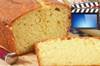
Irish Soda Bread has a
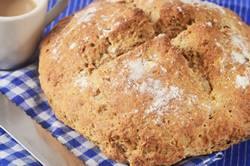
beautiful golden brown crust that's nice and crisp, yet inside the bread is soft and
tender. Have it with butter and jam for breakfast or it's excellent served alongside
a hot bowl of soup or stew. This bread is often served on Saint Patrick's Day
(March 17th), a day that honors its patron saint, Saint
Patrick. It is a national holiday in Ireland. Outside of Ireland, St. Patrick's
Day is celebrated by both the Irish and non-Irish. Parades, the wearing of
green, and the eating of Irish food has become very popular as "Everyone wants
to be Irish on St. Patrick's Day".
Irish cookbook and food lore author, Maura Laverty, tells us in her lovely
book Maura Laverty's Cookery Book that while outside of Ireland it
is known as
Irish 'soda
bread', locals often refer to it as "cake" or "cake-bread". In fact, soda bread
encompasses many types of quick breads; from a griddle bread,
to brown bread, to a treacle bread, to a currant and caraway
seed bread, to even a raisin soda bread (spotted dick or spotted dog). Yet
in its simplest form, Irish soda bread is made with just four ingredients;
flour, salt, baking soda, and buttermilk (or sour milk). Soda bread gets its
rise, not from yeast, but from the baking soda (bicarbonate of soda)
reacting with the acid (soured milk or buttermilk). There are debates
about whether Irish soda bread should be made from white or whole wheat flour,
so to satisfy both camps, this recipe uses both. I also like to add a
little sugar for sweetness but this, along with a small handful of old fashioned rolled
oats, is entirely optional. The important thing to remember when making soda bread is to have a
quick light hand for both mixing and kneading of the dough. Once the dough
is formed into a round, a cross is cut on the top of the bread, some say
to "let the fairies out". If truth be told, the cross is really there to
keep the bread from splitting during baking and it also makes it easier to
cut the baked bread into quarters.
Irish Soda Bread contains buttermilk which has a nice thick creamy
texture with a rich tangy buttery taste that makes this bread tender.
Whereas in the past it was the liquid left over after churning butter it
is now commercially made by adding a bacteria to whole, skim, or low fat
milk. You can make a good substitute for commercial buttermilk by adding 1
1/2 tablespoons of white
distilled vinegar, cider vinegar, or lemon juice to 1 1/2 cups (360 ml) of milk. Let
stand 5 to 10 minutes before using.
Irish Soda
Bread: Preheat your oven to 400
degrees F (200 degrees C) and place the rack in the center of the oven. Line
a baking sheet with parchment paper.
In a large
bowl, whisk together the flours, sugar, oats (if using), baking soda, and salt. Make a well in the
center of the flour mixture and add most of the buttermilk. Using your
hands, or a wooden spoon, mix (adding more buttermilk if necessary) until you
have a soft, and slightly sticky, dough.
Transfer to a lightly floured surface and
gently
knead the
dough into a 7 inch (18 cm) round. Place
the round on your prepared
baking sheet and then, with a sharp knife or clean kitchen scissors, cut a 1/4 inch
(.6 cm) deep "X" across the
top of the bread. Brush the surface of the bread with milk or cream (this helps
with browning).
Bake for
about 30 minutes or until nicely browned and a toothpick inserted into
the center of the bread comes out clean. You can also test that is fully baked
by tapping the bottom of the bread -
it should sound hollow. Remove from oven. This bread is wonderful when
served warm with butter and jam. It also makes great toast.
Use of materials on
all pages on the domains Joyofbaking.com,
the Joyofbaking.com Facebook
Page, the
Joyofbaking1 YouTube
Channel and any emails sent from @joyofbaking.com
are
entirely at the risk of the user and their owner, iFood Media LLC
will not be responsible for any damages directly or indirectly resulting
from the use.
References
cited may include a link to purchase the referenced book or item on Amazon.com.
Joyofbaking.com receives a commission on any purchases resulting from these
links.
This
website and the contents are not endorsed or sponsored by the owner of the
"Joy of Cooking" series of books or its publisher Simon & Schuster, Inc.
and is not related to the "Joy the Baker" books and website.
Video icons by Asher.
Content in any form may
not be copied or used without written permission of Stephanie Jaworski,
Joyofbaking.com. Students and non profit educators may use content without
permission with proper credit.